City Intelligence · 11/9/2026
Canopy Daily · Nov 9: San Francisco Enforces Tree Protection Rules While District 6 Canopy Inequity Sparks Scrutiny
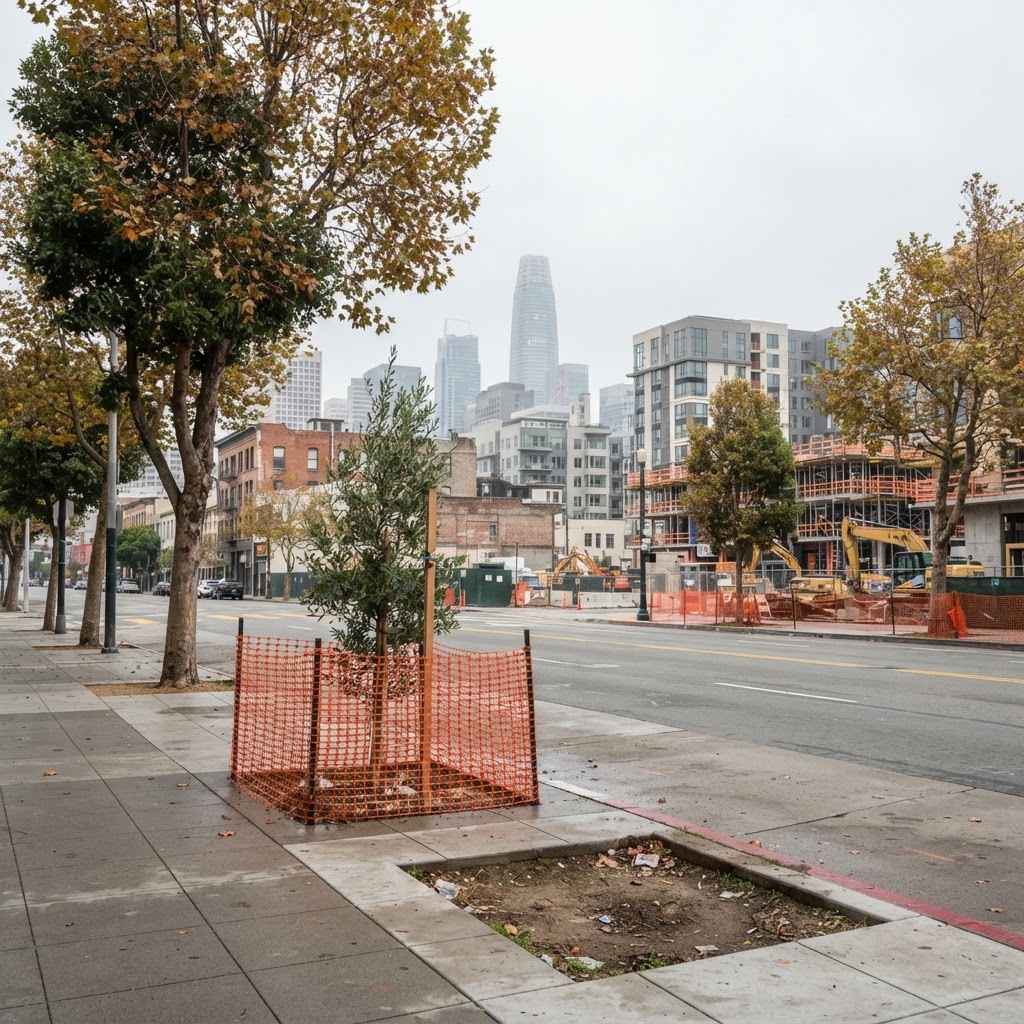
San Francisco officials and arborists are navigating recently enacted street tree code reforms alongside heightened oversight on construction-related tree protection. Meanwhile, community advocates continue pressing Public Works on vacant basins and low canopy coverage in vulnerable neighborhoods like SoMa.
Regulations & Permits
Following the enactment of Ordinance 186-26, which overhauled street tree compliance by establishing in-lieu fee pathways and exempting accessory dwelling units, the Department of Building Inspection and Public Works updated compliance guidance for development sites. Contractors and property owners must file an Existing Tree Disclosure and retain a certified arborist to draft a Tree Protection Plan whenever excavation or construction falls within the dripline of street or significant trees. Furthermore, Public Works continues processing contested removals, notably addressing cases where root severance during sidewalk uplift repairs risks tree destabilization.
Community Concerns
Equity advocates and neighborhood coalitions, such as FairTrees, continue to challenge the City's distribution of urban canopy resources, focusing on District 6 neighborhoods like South of Market (SoMa), where canopy coverage hovers around 2.7%. During legislative hearings and commission reviews, advocates pressed Public Works over hundreds of empty tree wells and criticized Public Works Order 187246, which restricts planting on sidewalks narrower than 7.5 feet. Bureau of Urban Forestry officials noted that while they aim to expand basin dimensions, persistent budget constraints hinder regular replacement planting and formal neighborhood-specific canopy targets.
Ecosystem Challenge & Solution
As autumn progresses into San Francisco's wet and windy storm season, tree stewards face compounded risks from sudden limb failures, wind-throw on root-pruned canopies, and pest declines such as severe Myoporum thrips infestations. Arborists should focus on structural pruning to reduce wind resistance, expand planting basins to prevent root-pavement conflicts, and avoid monocultures of susceptible ornamental species. To build climate and pest resilience, stewards should prioritize tough California natives such as Coast Live Oak (Quercus agrifolia) or Toyon (Heteromeles arbutifolia), which offer high wind tolerance and deep rooting systems adapted to local microclimates.
Volunteer & Planting
No specific upcoming volunteer planting dates were officially announced in recent Public Works notices. Community members interested in stewardship, street tree care, and basin maintenance are encouraged to connect directly with local urban forestry nonprofits, such as Friends of the Urban Forest, or monitor the Bureau of Urban Forestry's public calendars for seasonal volunteer plantings.