City Intelligence · 11/7/2026
Canopy Daily · Nov 7: Charlotte Enforces Heritage Tree Protections as Fall Riparian Plantings Approach
Data tracking Charlotte's Unified Development Ordinance shows millions raised for tree preservation alongside steady permit and fine enforcement. Local tree advocates and stewards are tackling post-storm riparian erosion across Mecklenburg County while gearing up for major fall planting events.
Regulations & Permits
City reporting on the Unified Development Ordinance (UDO) tree rules shows that the city has received 2,390 heritage tree removal requests, generating roughly $4.5 million in mitigation fees for the city's Canopy Care Program, according to reporting by WFAE. Heritage trees are classified as North Carolina native species measuring 30 inches or more in diameter at breast height (DBH), carrying mitigation requirements of $500 per tree for non-development scenarios and $1,500 per tree for development projects. City records also indicate that $53,760 has been assessed across 25 violations since January 2025 for unauthorized disturbance of heritage trees, underscoring the mandatory permit verification process before site work begins.
Community Concerns
Advocacy organizations like Sustain Charlotte have raised concerns that the current UDO framework may function more as a "pay-and-plant" system rather than encouraging genuine on-site heritage tree preservation, as cited by The Charlotte Ledger. Meanwhile, Charlotte City Council is acting to counteract canopy fragmentation by allocating funds to the Tree Canopy Preservation Program, including recent land acquisition along Riverside Drive by the Catawba River to preserve mature floodplain hardwoods damaged by severe storm events, as detailed in City of Charlotte Legislation.
Ecosystem Challenge & Solution
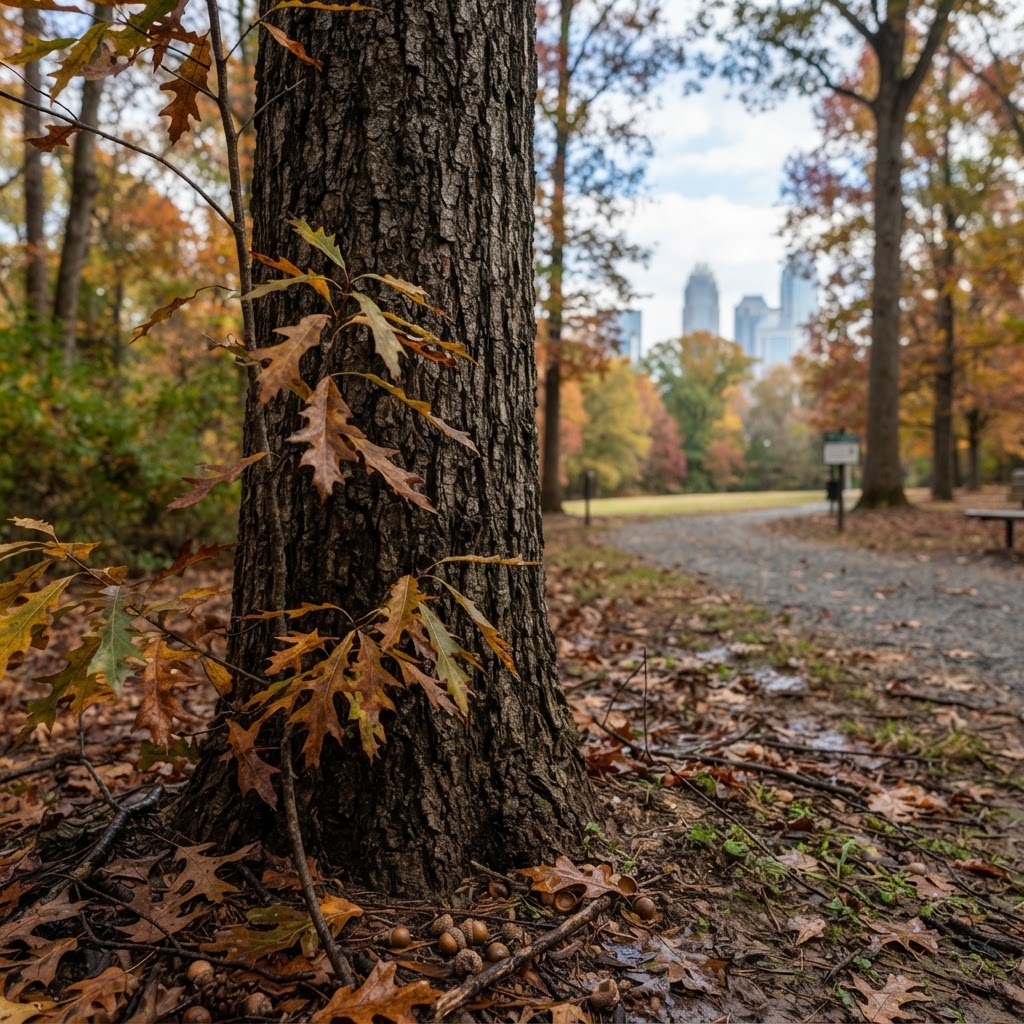
Seasonal riverbank erosion and severe storms have caused significant bank instability along Mecklenburg County stream corridors and floodplains. As a practical solution, local watershed managers are stabilizing floodplains through dormant-season live-staking and native hardwood re-establishment to anchor vulnerable stream buffers. Recommended native species include the Swamp White Oak (Quercus bicolor) and Pin Oak (Quercus palustris), which thrive in riparian zones, offer deep anchoring root networks, and withstand saturated Piedmont bottomland soils.
Volunteer & Planting
Multiple stewardship and adoption events are scheduled for November across the county. Today, November 7, 2026, TreesCharlotte hosts the North Charlotte TreeAdoption for zip codes 28216, 28269, and 28262, according to Charlotte On The Cheap. Additional opportunities include live-stake harvesting on November 11, the Charlotte East Language TreeDay planting and Chantilly Ecological Sanctuary cleanup on November 14, and staging prep on November 20 ahead of the annual Creek ReLeaf stream-buffer planting on November 21, as shared by Charlotte Wildlife Stewards and TreesCharlotte.