City Intelligence · 11/22/2026
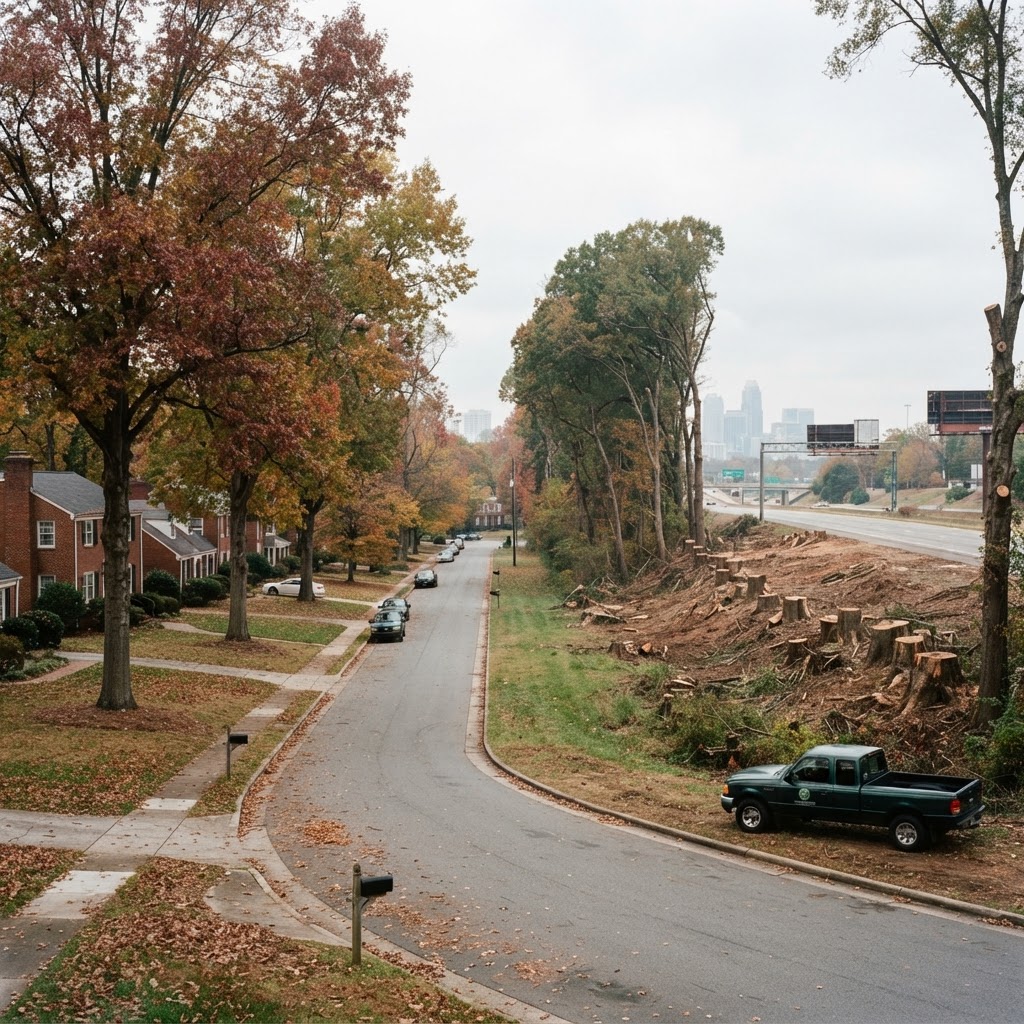
Canopy Daily · Nov 22: State Billboard Cuts Spark Local Pushback Across Mecklenburg County
Mecklenburg County faces growing canopy tension as state billboard-clearing permits bypass local tree protections, stripping highway buffers in Charlotte neighborhoods. Meanwhile, urban foresters and tree stewards are turning their focus to autumn riparian stabilization as major November volunteer drives conclude.
Regulations & Permits
State-level statutory changes enacted through the North Carolina Department of Transportation (NCDOT) are overriding municipal tree canopy protections in highway rights-of-way. NCDOT raised general vegetation-clearing permit fees to $400 but eliminated the tiered fee structure based on trunk size, reducing the cost for advertising firms to clear large canopy trees. As documented by WFAE, 40 active permits have been issued in Mecklenburg County allowing clearings of up to 500 feet per billboard site. Locally, Charlotte's Unified Development Ordinance (UDO) Article 20 and Tree Ordinance (Chapter 21) continue to mandate critical root zone protections and non-development heritage tree permits ($1,500 for development mitigation, $500 for non-development removals), which have generated roughly $4.5 million across nearly 2,400 permits to date, according to reporting by the Charlotte Observer.
Community Concerns
Residents, small business owners, and advocacy groups such as Sustain Charlotte are mobilizing against extensive tree removals along highway corridors, including Plaza Midwood and Enderly Park. As detailed by Axios Charlotte and WFAE, contractors for billboard companies including Adams Outdoor Advertising recently removed hundreds of trees along Interstate 85 and Independence Boulevard to improve sign visibility. Impacted neighborhoods report sudden increases in traffic noise, loss of visual buffering, and heightened heat-island vulnerability, prompting calls for state lawmakers to reconsider public right-of-way tree-removal privileges.
Ecosystem Challenge & Solution
Late autumn brings severe bank destabilization and sediment runoff to Mecklenburg County's urban stream corridors following seasonal rainstorms and canopy dieback. Stripped floodplains along waterways such as Briar Creek and Long Creek experience acute erosion, threatening aquatic habitats and stormwater conveyance. A practical, high-impact management solution is installing protective tree tubes, weed mats, and stakes around bare-root saplings planted during the dormant window (November through March). Land stewards are encouraged to plant River Birch (Betula nigra), a resilient native riparian species whose dense fibrous root system stabilizes stream edges, absorbs excess stormwater runoff, and tolerates seasonal inundation.
Volunteer & Planting
The major local planting drive of the season, the annual Creek ReLeaf program on Long Creek Greenway organized by the Charlotte Public Tree Fund, Charlotte-Mecklenburg Storm Water Services, and the North Carolina Wildlife Federation, concluded yesterday on November 21, as noted by the Charlotte Public Tree Fund. No new tree-planting volunteer events are scheduled for today, November 22, 2026. The next confirmed stewardship event on the regional calendar is the Keep Charlotte Beautiful cleanup on Tyvola Road scheduled for December 5, 2026, with further winter dormant-season tree planting dates to be announced by local canopy organizations.