City Intelligence · 11/24/2026
Canopy Daily · Nov 24: Boston Balances Urban Wild Conservation and Private Tree Losses
Advocacy continues across Boston to protect remaining urban wild tracts like Crane Ledge Woods, even as significant canopy loss on private residential lots offsets gains made on public lands. In late fall, arborists and stewards are focused on safeguarding public shade trees, combating invasive pests, and wrapping up active seasonal street plantings.
Regulations & Permits
Under Massachusetts General Law Chapter 87 and the amended City of Boston Code (Chapter VII, Section 7-4.7), all public shade trees and trees located on city-owned property remain strictly protected, requiring formal tree hearings before removal. As of today, no public tree removal hearings are scheduled by the Parks and Recreation Department. For arborists and contractors, private property trees remain exempt from city ordinances, leaving residential removals unregulated despite canopy advocacy.
Community Concerns
Community attention centers on the preservation of Crane Ledge Woods—Boston's largest unprotected 24-acre urban wild along Mattapan, Roslindale, and Hyde Park—where coalition members are urging city leaders and the Urban Forestry Advisory Committee to pursue a willing-seller conservation acquisition. Simultaneously, local tree stewards express deep concern over recent assessments indicating that unregulated tree felling on private residential lots has erased roughly 120 acres of canopy, blunting public canopy expansion in heat-vulnerable neighborhoods.
Ecosystem Challenge & Solution
Late-fall urban conditions present severe threats from soil compaction and road salt runoff alongside the ongoing spread of invasive pests such as the Spotted Lanternfly and Emerald Ash Borer. Practical mitigation includes applying a 2- to 4-inch protective layer of aged arborist wood chip mulch around tree bases (keeping mulch away from root flares) to buffer roots from freeze-thaw cycles, improve compacted soils, and absorb toxic runoff. For resilient future canopy plantings, the city recommends native species such as Swamp White Oak (Quercus bicolor), which demonstrates exceptional tolerance to urban compaction and variable soil conditions.
Volunteer & Planting
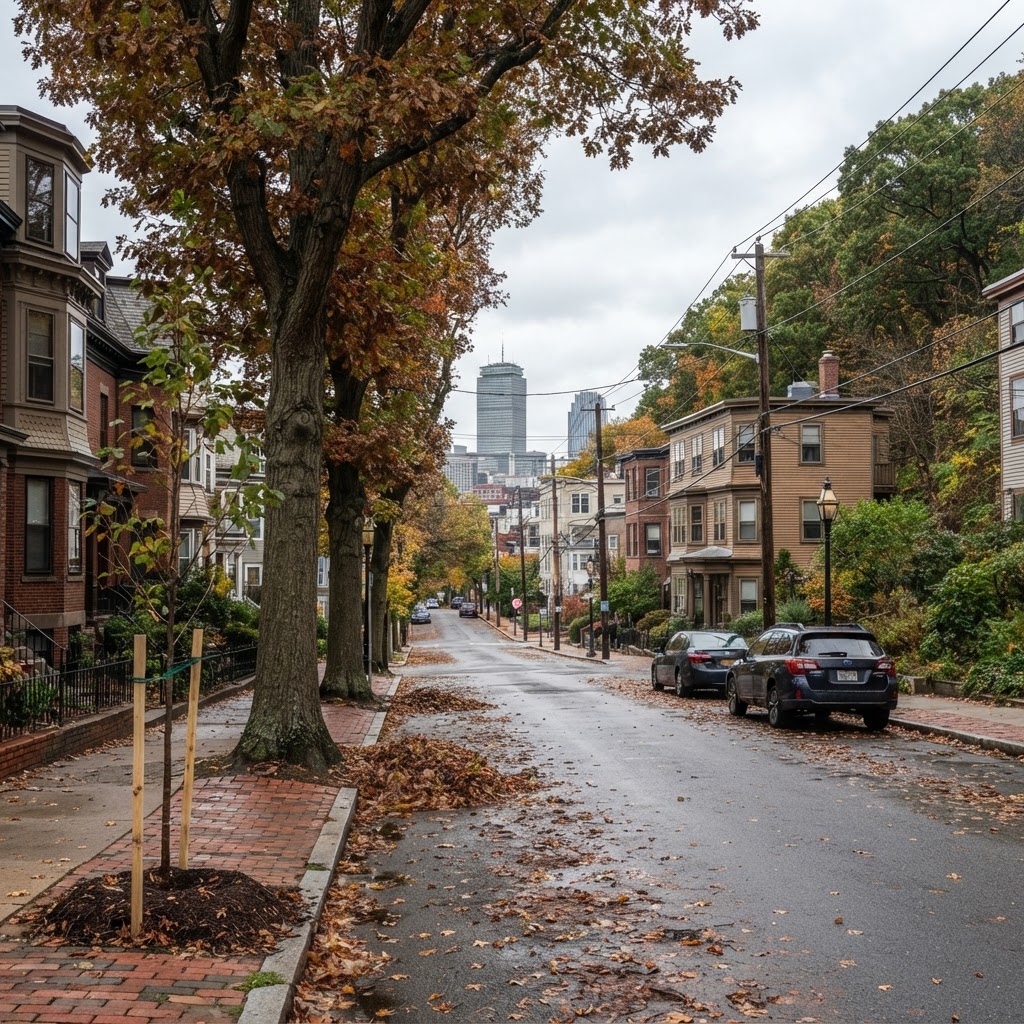
The Urban Forestry Division's official fall street tree planting window (October through December) is actively wrapping up, with contractors completing installations across public rights-of-way. While recent grant deadlines closed earlier this month, residents can steward young street trees by reporting hazards or planting requests via 3-1-1. No specific public volunteer planting dates were announced for today, though nonprofit partners like Tree Boston and the Boston Tree Alliance continue ongoing community stewardship and maintenance programs.