City Intelligence · 11/21/2026
Canopy Daily · Nov 21: DC Advances Tree Protections and Fall Canopy Restoration Amid Regional Strategy Push
The Metropolitan Washington Council of Governments has finalized its Tree Canopy and Forest Action Plan as DC enforces expanded Special Tree thresholds under recent legislative updates. Meanwhile, local arborists and volunteers focus on late-autumn planting events and vigilant monitoring for emerging pests and diseases across the District.
Regulations & Permits
Under the D.C. Law 26-113: Tree Preservation Enhancement Amendment Act of 2026, the minimum threshold for protected 'Special Trees' remains lowered from 44 inches to 40 inches in circumference (approximately 12.8 inches in diameter), bringing thousands of additional trees under strict DDOT Urban Forestry Division (UFD) oversight. Contractors and arborists working on site design or infill projects must submit a Tree Preservation Plan through the Transportation Online Permitting System (TOPS) before impacting regulated roots or canopies, and non-exempt Heritage Trees (100 inches in circumference or larger) remain legally protected from removal. The updated law also mandates inflation-adjusted fines and permit fees and directs Tree Fund revenues to include income-based subsidies for hazardous tree mitigation.
Community Concerns
Canopy preservation remains at the forefront of civic advocacy following major pushback against park tree clearings, notably highlighted by legal battles over extensive National Park Service removals at East Potomac Park detailed by Casey Trees. The debate coincides with regional policy adoption; on November 18, 2026, the Metropolitan Washington Council of Governments reviewed its Tree Canopy and Forest Action Plan. The plan emphasizes that aggressive development and by-right tree removals threaten both the regional 50% tree canopy goal and DC's target of reaching 40% canopy cover by 2032.
Ecosystem Challenge & Solution
A prominent late-autumn forest health threat across the District is the spread of invasive pests and emerging pathogens, particularly spotted lanternfly (SLF) egg masses deposited on tree bark and recent local detections of Beech Leaf Disease reported in regional forestry assessments by the U.S. Forest Service. Tree stewards and property owners are urged to inspect trunks, outdoor furniture, and posts to scrape and destroy flat, mud-like SLF egg masses before spring. When replacing vulnerable or lost canopy, arborists recommend diversifying plantings with resilient native hardwoods such as swamp white oak (Quercus bicolor) or American hornbeam (Carpinus caroliniana).
Volunteer & Planting
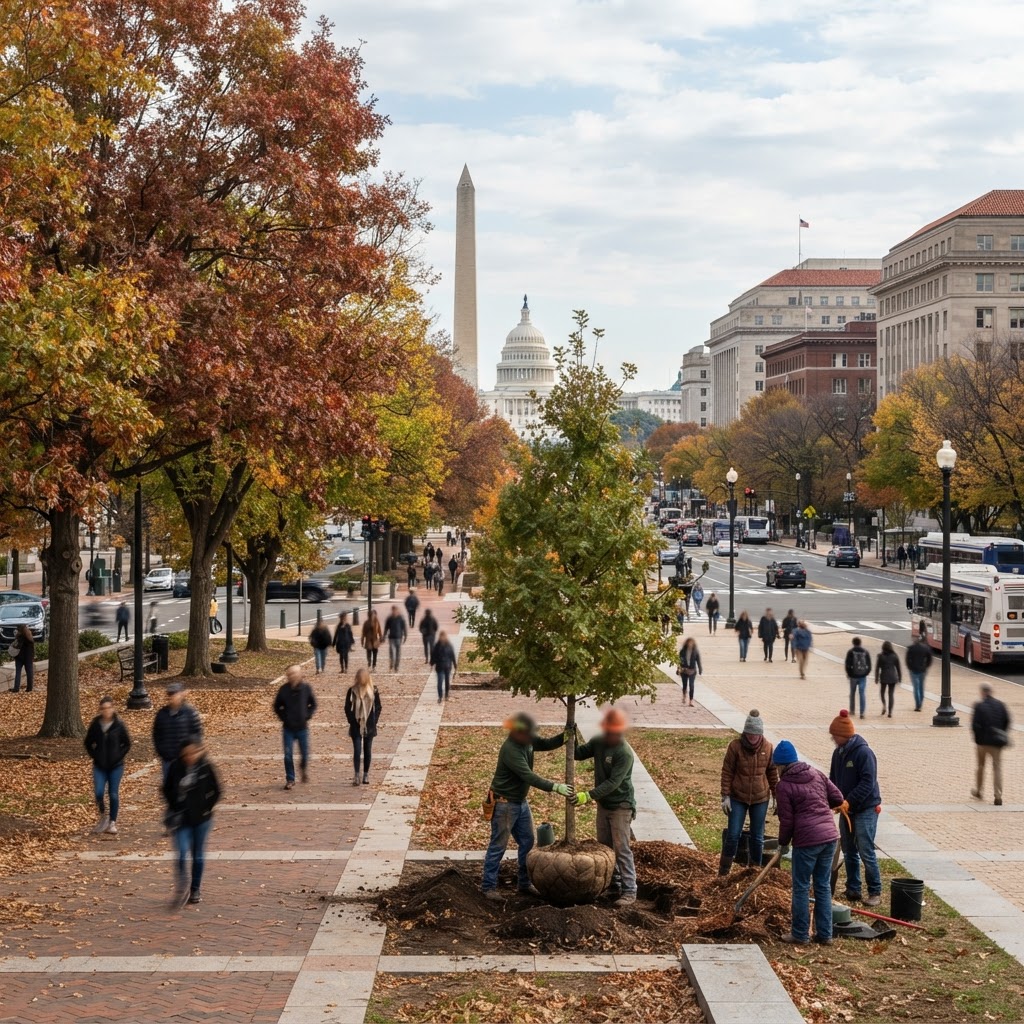
Stewardship and planting events are underway across the District during the optimal cool-weather planting window. According to the Capital Nature Events Calendar, Casey Trees is hosting a Community Tree Planting on November 21, 2026, from 8:00 AM to 12:00 PM at Rock Creek Cemetery, providing tools, training, and team leaders for volunteer tree establishment. Residents and stewards are encouraged to check with local urban forestry groups for additional late-autumn planting and tree-care sessions throughout the wards.