City Intelligence · 11/15/2026
Canopy Daily · Nov 15: Canopy Daily Boston: Autumn Moisture Relief and Urban Forest Stewardship Across Suffolk County
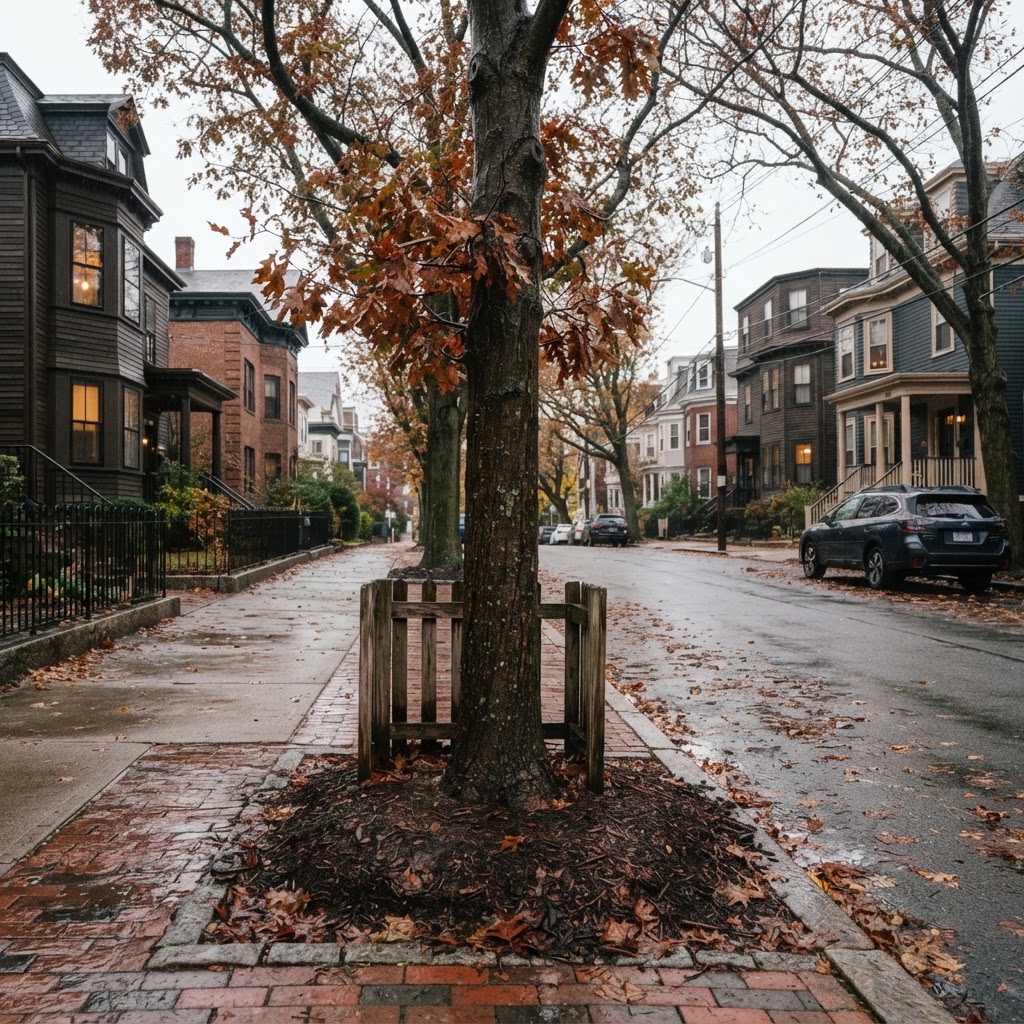
Recent soaking rains in early November have replenished soil moisture for Boston's newly established transplants following an extended dry fall. Meanwhile, urban forestry advocates continue navigating the gap between public shade tree protections and the ongoing loss of private residential canopy.
Regulations & Permits
Public shade trees across Boston remain strictly protected under Massachusetts General Law Chapter 87 and the amended City of Boston Code Section 7-4.7, which governs trees on city-owned property and restricts pruning or removal to the Urban Forestry Division and authorized contractors (Urban Forestry | Boston.gov). While public tree removal hearings—typically held the first Thursday of each month—continue under Tree Warden oversight (How to Request a Tree Removal Hearing | Boston.gov), the City of Boston's hearing portal reports no new tree removal hearings scheduled as of mid-November 2026 (Participate In The Public Tree Ordinance Process | Boston.gov). Arborists and contractors working near city property must ensure all required permits and hearing filings are cleared through the Parks and Recreation Department prior to any planned curb cuts, utility work, or construction impacts.
Community Concerns
Canopy advocates and neighborhood groups continue to highlight the ongoing loss of mature trees on private residential land, where roughly 60% of Boston's urban canopy resides without municipal or state tree ordinance protection (Boston plants trees to cool hotter neighborhoods, but residents keep cutting them down, Boston Tree Alliance). Although recent canopy assessments show a net gain of 151 acres driven primarily by municipal plantings in parks and public rights-of-way, backyard removals across environmental justice and heat-vulnerable neighborhoods remain an unaddressed challenge (Tree Canopy Assessment Report Released | Boston.gov, Boston plants trees to cool hotter neighborhoods, but residents keep cutting them down). Grassroots coalitions and the Urban Forestry Advisory Committee continue advocating for creative preservation tools, such as pedestrian easements and expanded private planting partnerships, to retain private tree cover.
Ecosystem Challenge & Solution
According to the UMass Extension Landscape Message for the Boston area, Suffolk County experienced an extended dry spell with zero precipitation from mid-October through early November, demanding supplemental irrigation for autumn transplants before a series of soaking storms provided roughly 2.6 inches of rain to recharge soils ahead of winter dormancy (Landscape Message: November 13, 2026 : Center for Agriculture, Food, and the Environment (CAFE) at UMass Amherst). Additionally, arborists report diminished fall color from late-season foliar leaf blights, making sanitation—specifically collecting and disposing of infected fallen leaves—a critical practical fix to reduce overwintering fungal inoculum (Landscape Message: November 13, 2026 : Center for Agriculture, Food, and the Environment (CAFE) at UMass Amherst). For late-fall planting in compacted or exposed urban sites subject to coastal or road-salt exposure, practitioners recommend tough native canopy trees such as swamp white oak (Quercus bicolor) or red maple (Acer rubrum), which establish resilient root structures and handle urban soil variability.
Volunteer & Planting
The Boston Urban Forestry Division is actively conducting its regular fall planting cycle, which runs through December to install replacement street trees across city neighborhoods (Urban Forestry | Boston.gov). Concurrently, the Boston Tree Alliance—supported by Mass Audubon and the City of Boston—is advancing sub-grant funded projects that deploy community groups to plant and steward trees on private parcels in heat-vulnerable areas (Boston Tree Alliance, BTA Case Studies - Boston.gov). While city calendar notices list no specific community volunteer planting events scheduled for today, residents and neighborhood tree stewards can submit 311 requests for spring 2027 street tree planting locations or connect with Mass Audubon and local non-profit partners for upcoming private-land tree care cohorts.