City Intelligence · 11/14/2026
Canopy Daily · Nov 14: Boston Balances Fall Planting With Private Property Canopy Losses
While the City of Boston's Urban Forestry Division wraps up its active autumn planting window, local canopy advocates continue to navigate persistent tree loss on private residential land. Arborists and stewards are focusing on late-season root care and soil insulation ahead of winter, even as no new tree removal hearings are currently posted.
Regulations & Permits
Public shade trees along Boston's sidewalks and parks remain strictly protected under Massachusetts General Law Chapter 87 and City of Boston Code Section 7-4.7, mandating formal hearings with Tree Warden Max Ford-Diamond for removals (City of Boston Ordinance Protecting Trees on Public Property). The city's official hearing portal currently reports no upcoming tree removal hearings or community tree meetings scheduled at this time (Participate In The Public Tree Ordinance Process | Boston.gov). For certified contractors and arborists working near public right-of-ways, all sidewalk tree pruning remains exclusive to municipal staff and authorized vendors.
Community Concerns
Canopy advocates and community organizations are raising concerns over continued tree losses on privately owned residential properties across Boston neighborhoods (Boston plants trees to cool hotter neighborhoods, but residents keep cutting them down). While the city added over 170 acres of canopy on municipal land over recent assessment periods, approximately 120 acres were removed by residential landowners where municipal shade tree ordinances do not apply (Boston plants trees to cool hotter neighborhoods, but residents keep cutting them down). The Urban Forestry Advisory Committee continues to prioritize canopy equity, focusing on neighborhood heat mitigation where yard removals undercut municipal gains (Urban Forestry Advisory Committee | Boston.gov).
Ecosystem Challenge & Solution
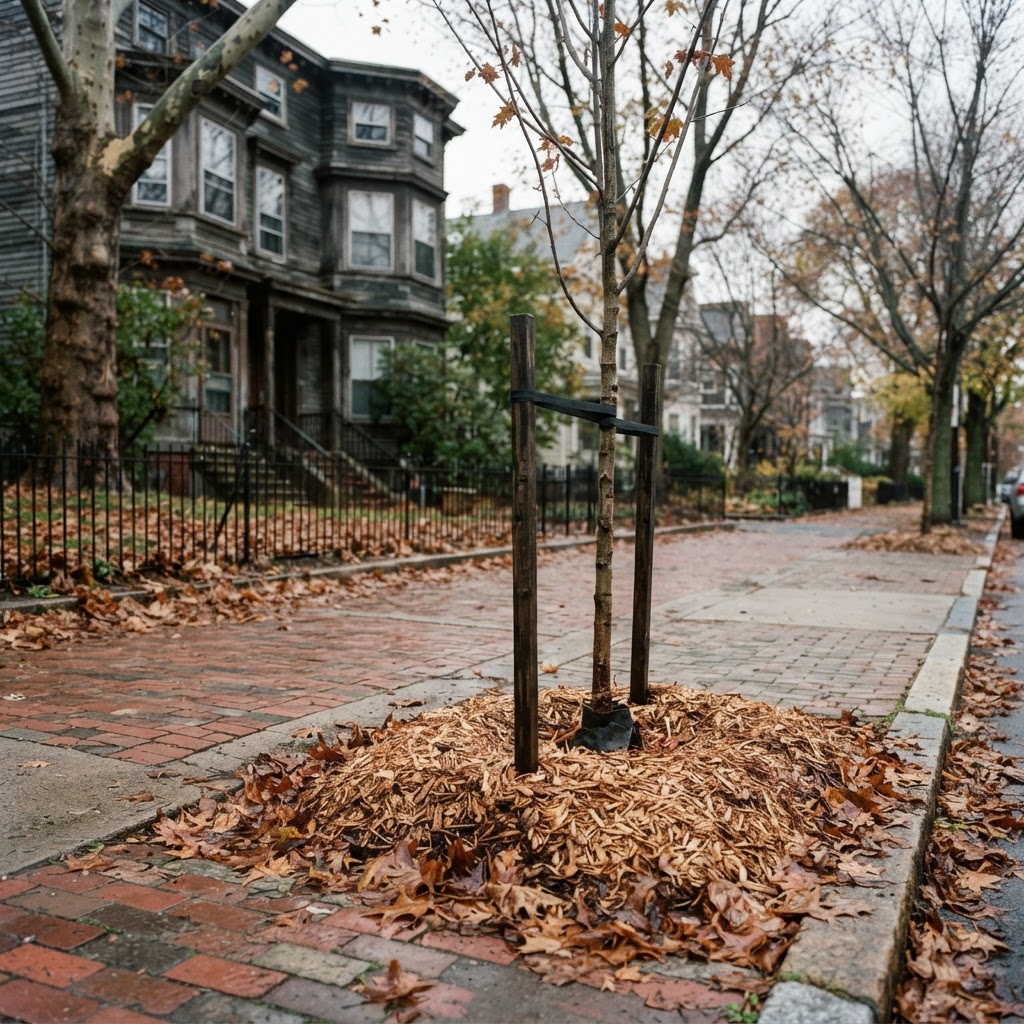
Mid-November brings freezing soil cycles, desiccating coastal winds, and exposure to de-icing salt sprays along Boston thoroughfares (Boston Tree Alliance). To safeguard root zones of newly planted saplings before ground freeze, stewards should apply a 2- to 4-inch layer of organic wood mulch, keeping it away from root flares to prevent moisture rot and rodent nesting. For street-adjacent and saline environments, planting salt- and compaction-tolerant native species such as the Swamp White Oak (Quercus bicolor) provides resilient winter dormancy and strong urban ecosystem support.
Volunteer & Planting
The Urban Forestry Division is actively concluding its scheduled fall planting cycle, which runs through December to install replacement shade trees across city neighborhoods (Urban Forestry | Boston.gov). While public tree planting grant applications through the Boston Tree Alliance closed on November 6, 2026 (Apply for a Tree Planting Grant | Boston.gov), residents can request future street tree pit cuttings and saplings in front of their homes via the city's 3-1-1 service (Urban Forestry | Boston.gov). No new specific volunteer planting events were announced for this weekend.