City Intelligence · 11/14/2026
Canopy Daily · Nov 14: LA County Weighs Major Oak Tree Code Overhaul as Region Confronts Late-Fall Oak Borer Risks
Los Angeles County arborists and residents are reviewing a newly released preliminary draft update to the Oak Tree Permit Ordinance ahead of an upcoming public hearing. Meanwhile, urban forestry advocates and county foresters are addressing canopy equity imbalances alongside seasonal threats posed by invasive pests like the Goldspotted Oak Borer.
Regulations & Permits
Los Angeles County Planning has released the Preliminary Draft of the Oak Tree Permit Ordinance Update for public review through late 2026, with a virtual public meeting scheduled for Wednesday, November 18, 2026. Under existing regulations in unincorporated areas, an Oak Tree Permit is mandatory for pruning roots or branches over 2 inches in diameter, encroaching into the protected zone (the dripline plus 5 feet or 15 feet from the trunk), or removing protected oaks (measuring 8 inches DBH, or 6 inches DBH in Significant Ecological Areas and the Santa Monica Mountains). Any impact to heritage oaks (36 inches DBH or greater) continues to require an Oak Tree Permit subject to a public hearing. In nearby municipal actions, the San Dimas City Council voted on November 10, 2026, to continue debate on Ordinance 1326—which considers exempting single-family properties from certain tree preservation rules—to January 26, 2027.
Community Concerns
Canopy equity remains a central advocacy topic across Los Angeles County, where historically underserved neighborhoods face significant shade deficits and urban heat island effects. Implementation efforts under LA County's Community Forest Management Plan ('Room to Grow') highlight persistent obstacles in unincorporated parkways, where establishment rates lag due to multi-year resident watering commitments. Additionally, community tree-planting organizations have raised concerns with the Los Angeles City Council regarding technical and financial hurdles tied to mandatory street tree root barrier enforcement (Standard Plan S-456-2), cautioning that rigid installation mandates can strain non-profit planting budgets.
Ecosystem Challenge & Solution
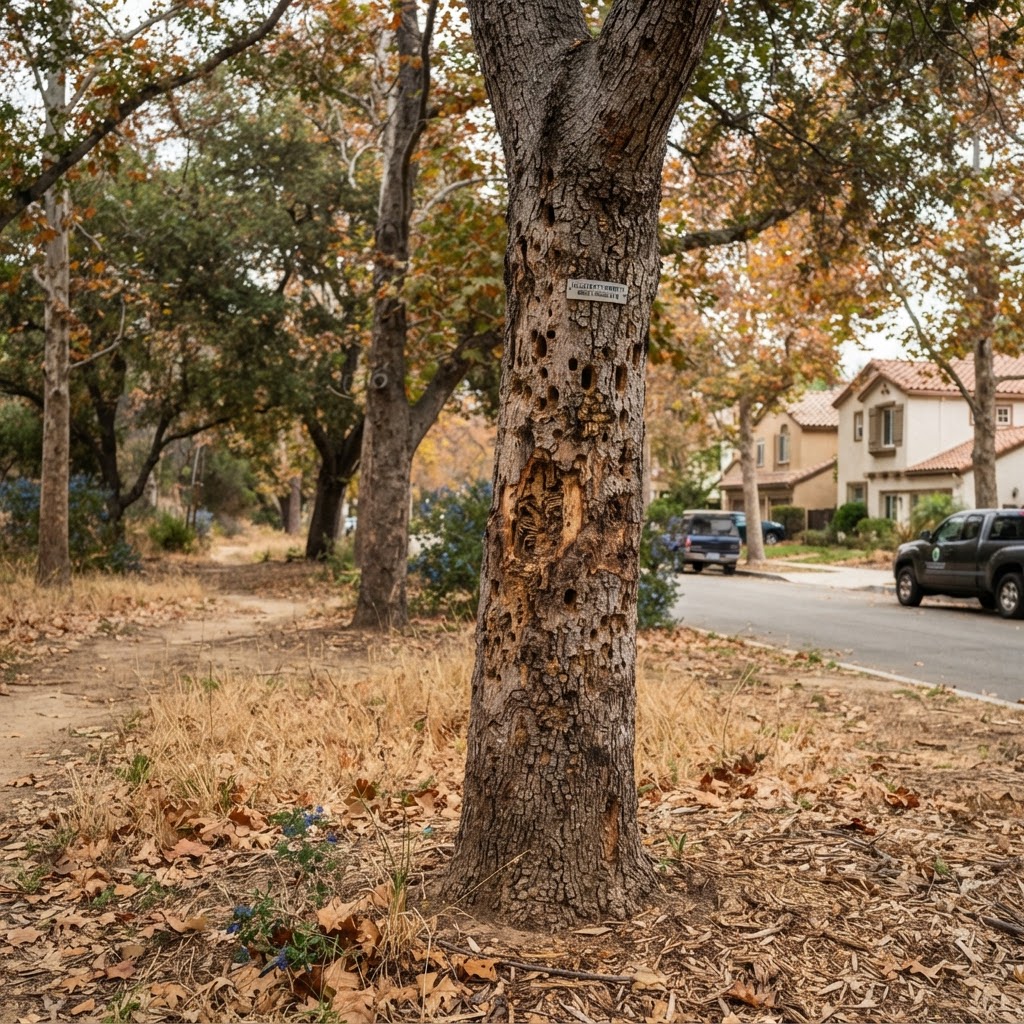
Late-fall conditions and prolonged regional drought continue to elevate oak vulnerability to the invasive Goldspotted Oak Borer (GSOB, Agrilus auroguttatus), which girdles and kills native oak stands across Southern California. Arborists and tree stewards should inspect coast live oaks and canyon live oaks for D-shaped exit holes, bark staining, and crown thinning; suspected infestations in unincorporated areas can be referred to the LA County Fire Department Forestry Division for inspection. To strengthen local canopy resilience, stewards are advised to plant coast live oak (Quercus agrifolia) or valley oak (Quercus lobata) in appropriate spaces, maintain a wide mulch ring over root zones, and enforce strict biosecurity by burning or chipping infested firewood locally rather than transporting it.
Volunteer & Planting
No specific single-day volunteer planting events were announced for today, November 14, 2026. However, active urban canopy expansions continue through the LA Sanitation & Environment Tree Planting Program and partner initiatives like 'BeLeaf in Equity,' which collaborates with City Plants and StreetsLA to convert concrete parkways into active planting wells around schools and transit corridors in low-canopy neighborhoods.