City Intelligence · 11/11/2026
Canopy Daily · Nov 11: Boston Advances Fall Street Tree Operations Amid Continuing Debates Over Private Canopy Loss
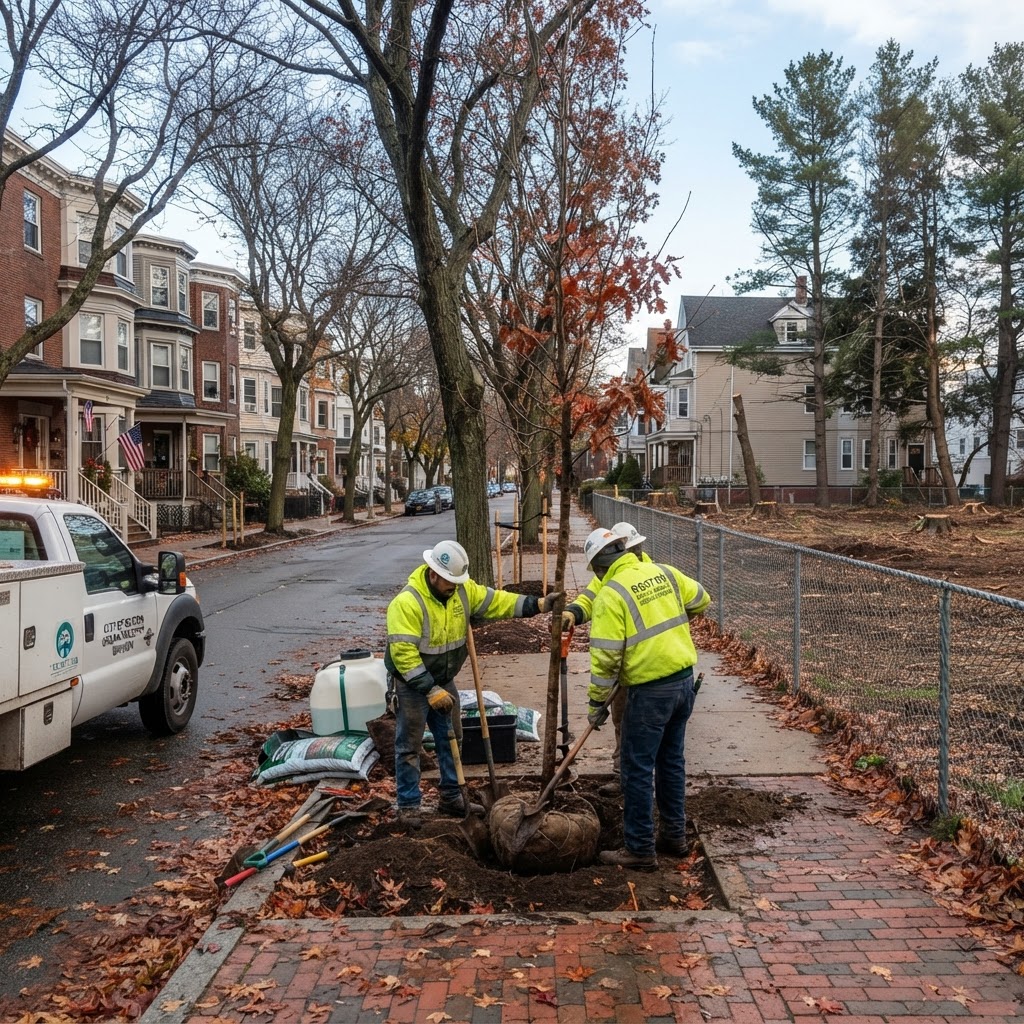
Boston's Urban Forestry Division is actively managing fall planting and street tree maintenance across public rights-of-way, balancing canopy expansion with ongoing pest challenges. At the same time, community advocates continue to push for solutions addressing tree removals on private property, which accounts for the majority of the city's urban forest.
Regulations & Permits
Boston operates under its Public Tree Ordinance, which mandates formal public hearings under Massachusetts General Laws Chapter 87 for any proposed removals of protected public shade trees. According to the City of Boston's Urban Forestry Division, there are currently no new public tree removal hearings scheduled. While neighbor communities enforce private tree mitigation rules, Boston does not regulate or require permits for tree removals on private property, meaning tree work on private residential land continues to proceed without municipal tree code permit restrictions.
Community Concerns
Canopy advocacy groups and residents remain focused on the steady loss of mature trees on privately owned parcels, which make up roughly 60% of Boston's overall urban canopy, as highlighted by reporting from The Cooldown. Recent local 311 logs also reflect neighborhood frustration over municipal vehicle impacts, including reports of recurring branch damage to street trees from trash trucks along narrow roadways, underscoring calls for better infrastructure coordination and canopy preservation.
Ecosystem Challenge & Solution
Spotted Lanternfly (Lycorma delicatula) populations continue to pose an emerging threat across Boston parklands and public rights-of-way, as documented by the Urban Forestry Advisory Committee. Arborists and stewards are urged to perform late-autumn inspections on tree bark, outdoor posts, and hardscaping to locate and scrape away mud-like egg masses before spring hatch. For replacement and diversification plantings, stewards should consider resilient regional natives such as swamp white oak (Quercus bicolor), which withstands urban soil compaction and avoids serving as a primary host for preferred lanternfly infestation.
Volunteer & Planting
The Urban Forestry Division is in the midst of its fall planting initiative, targeting roughly 600 new street trees before the winter freeze window closes. The city, in collaboration with Mass Audubon, recently concluded the intake for the 2027 Boston Tree Alliance grant cycle to fund future canopy efforts on private property, as detailed on Boston.gov. No new general public volunteer planting days are scheduled for today; stewards and residents interested in participating in upcoming tree-care initiatives are advised to connect directly with local neighborhood tree alliances or monitor Parks and Recreation announcements.