City Intelligence · 11/10/2026
Canopy Daily · Nov 10: Boston Expands Canopy Care Amid Mounting Debate Over Private Tree Protections
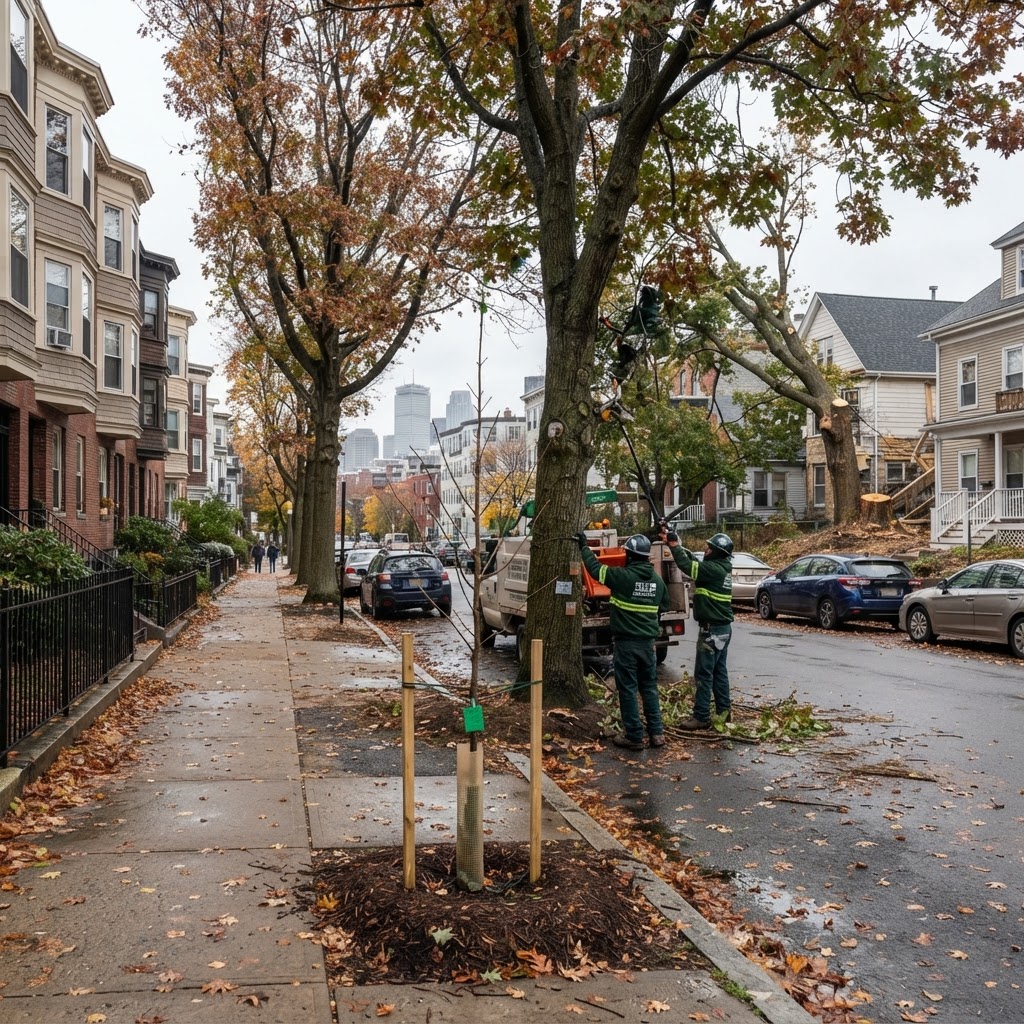
The City of Boston is advancing fall street tree planting and maintenance across Suffolk County while balancing severe canopy losses on private property. Arborists and neighborhood tree stewards are confronting ongoing challenges with spotted lanternfly infestations and equity gaps in canopy coverage.
Regulations & Permits
In Boston, public shade trees and sidewalk trees remain strictly regulated under Massachusetts General Law Chapter 87 and the municipal Public Tree Ordinance, meaning only the City's Urban Forestry Division and designated contractors are authorized to prune or remove them (City of Boston). However, the city does not currently enforce tree removal ordinances or permit requirements for trees on private property, unlike neighboring Cambridge where permits and mitigation payments are mandated (The Cool Down). City officials continue to explore alternative policy tools, including potential pedestrian easements that would allow municipal planting and maintenance on private residential margins.
Community Concerns
Canopy advocacy groups and the Urban Forestry Advisory Committee remain focused on private land canopy loss and neighborhood equity (City of Boston Urban Forestry Division). Recent city canopy assessments revealed that while Boston added over 170 acres of tree cover on public property between 2019 and 2024, approximately 120 acres were removed on private residential parcels due to development, views, or insurance demands (The Cool Down). With over 60% of the city's tree canopy situated on private land, advocates emphasize that public planting alone cannot outpace private deforestation in urban heat islands.
Ecosystem Challenge & Solution
Urban forestry teams across Boston parks have observed populations of the invasive spotted lanternfly (Lycorma delicatula) (City of Boston Urban Forestry Division). During late autumn, stewards and arborists can mitigate spread by identifying and destroying egg masses—laid on tree trunks, stones, and outdoor structures—before they hatch in spring, alongside removing preferred invasive hosts such as tree of heaven (Ailanthus altissima). For replacement and canopy diversification, resilient native canopy species like the swamp white oak (Quercus bicolor) provide strong environmental tolerance to urban soils and pests.
Volunteer & Planting
The Urban Forestry Division is executing its active fall planting window with a target of 600 street trees across Boston neighborhoods (City of Boston Urban Forestry Division). While the Boston Tree Alliance's $688,000 grant application cycle for private-land planting projects just closed on November 6, 2026 (City of Boston), grassroots community groups such as Tree Eastie and Tree Boston continue neighborhood maintenance and tree care activities (City of Boston). No specific one-off public volunteer planting dates were announced for this week.