City Intelligence · 11/8/2026
Canopy Daily · Nov 8: Los Angeles Previews Oak Ordinance Draft and Tackles Planting Spacing Rules
Los Angeles County is currently soliciting public input on a revised draft of its Oak Tree Permit Ordinance, while City of Los Angeles leaders and arborists reexamine restrictive street spacing standards and root-barrier requirements. As dry autumn Santa Ana wind patterns elevate fire-weather risks, urban forestry groups emphasize soil-volume structural cells and native oak stewardship across Southern California.
Regulations & Permits
Los Angeles County Planning released a Preliminary Draft updating the LA County Oak Tree Program Ordinance for public review through late 2026, scheduling a virtual public feedback session for November 18, 2026. Concurrently, the City of Los Angeles continues legislative momentum on Council File 26-1050 to modernize street tree spacing guidelines—prompted by USC research showing current clearance mandates near utilities and curb lines unnecessarily suppress planting capacity by up to 26 percent in dense neighborhoods, as reported by Spectrum News 1. Additionally, city departments are evaluating state-mandated 'Zone Zero' (0–5 feet) ember-resistant regulations to balance wildfire defensible space compliance with preserving hillside canopy integrity.
Community Concerns
Urban forestry nonprofits, including North East Trees and the South LA Tree Coalition, have voiced significant concerns over universal root-barrier mandates enforced by city bureaus (Communication from Public). Advocates argue that rigid, across-the-board barrier rules impede grant-funded plantings in historically shaded-deprived neighborhoods such as Council Districts 1, 9, 13, 14, and 15 by constricting structural roots and ignoring site-specific soil needs. Concurrently, the Community Forest Advisory Committee (CFAC) and local council motions are advocating for structural soil cells (such as Silva Cells) and dedicated funding to safely reforest over 74,000 documented vacant street tree wells across the city (CF26-1333 Public Works Motion).
Ecosystem Challenge & Solution
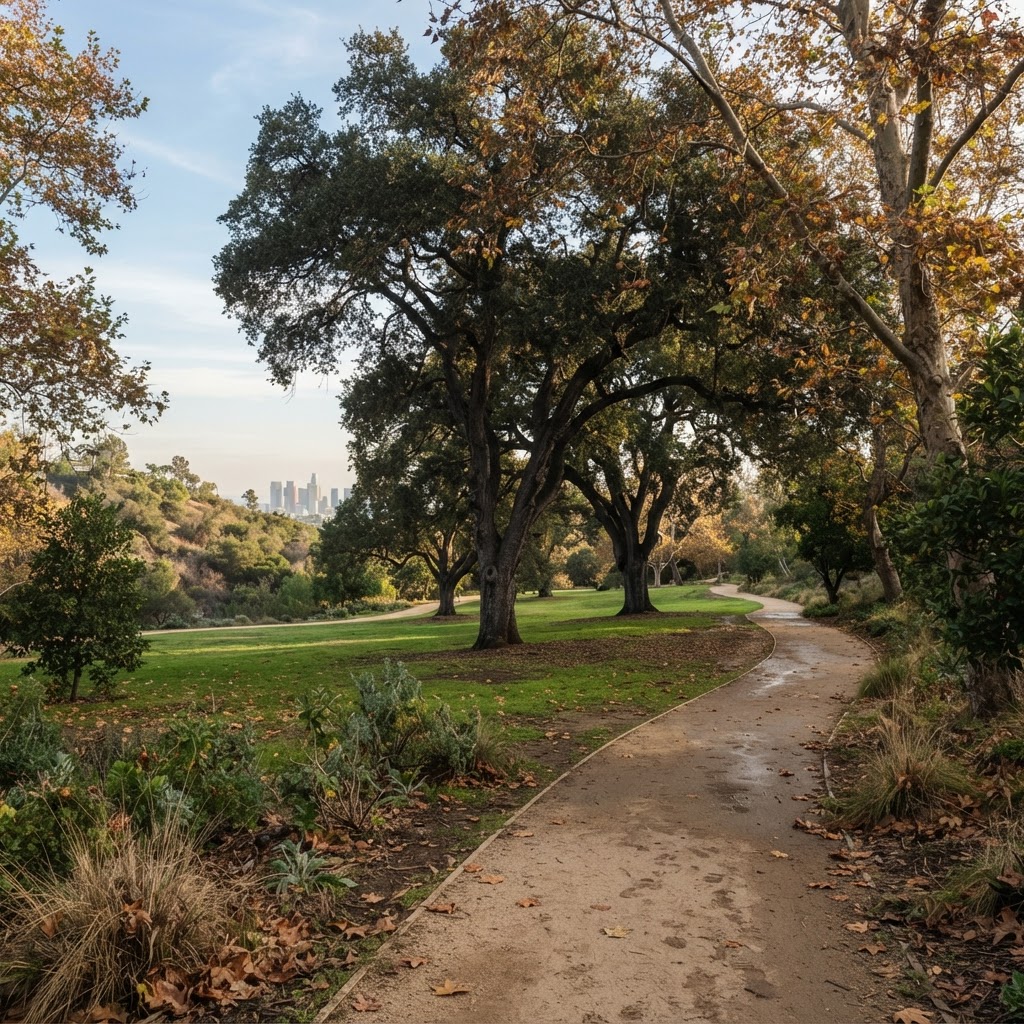
November marks the height of the offshore Santa Ana wind season in Southern California, compounding low soil moisture, desiccating vulnerable branches, and creating severe wildland-urban interface fire hazards. Tree stewards and arborists should inspect canopies to prune out dead, weak, or crossed limbs to reduce wind drag and mitigate ember fuel loading, while refreshing a 2- to 4-inch coarse wood chip mulch layer out to the drip line (keeping it clear of root flares) to retain baseline root-zone moisture. For long-term ecological resilience and canopy expansion, plant the coast live oak (Quercus agrifolia), an indigenous, deep-rooting keystone species adapted to withstand seasonal drought and high wind exposure when given appropriate soil volume.
Volunteer & Planting
No specific single-day planting events were formally scheduled for today, but ongoing seasonal stewardship resources remain accessible across the county. The Los Angeles County Fire Department's Forestry Division continues to provide free oak tree seedlings to qualified residents by advance appointment through its nursery facilities, including the Malibu Forestry Unit in Calabasas (LA County Oak Tree Program). In addition, community members and neighborhood volunteers can register for street tree care and yard-tree adoption drives administered throughout the fall by City Plants and partner planting organizations.