City Intelligence · 11/23/2026
Canopy Daily · Nov 23: Canopy Daily Beaverton: Navigating Emerald Ash Borer Response, Right-of-Way Pruning Standards, and Urban Biodiversity
Following Beaverton's first confirmed detections of emerald ash borer, winter maintenance and seasonal ash removal work are underway under strict municipal right-of-way standards. Meanwhile, local canopy advocates are pushing for enhanced pollinator corridors and balanced riparian management alongside urban wildlife.
Regulations & Permits
No recent updates to the city's tree code have been enacted since the codification of Ordinance 4883 in August 2026. Arborists and contractors working in Beaverton must continue complying with Beaverton Municipal Code 5.05.102, which strictly requires a city-issued permit and payment of required fees prior to removing or destroying any street tree within the public right-of-way (ROW), alongside mandatory replacement with approved species. Work within the ROW must adhere to International Society of Arboriculture (ISA) standards, comply with overhead clearance mandates (14 feet over arterials, 12 feet over other roadways, and 8 feet over pedestrian paths under BC 5.05.102 and BC 5.05.098), and avoid unpermitted soil compaction or excavation in root zones.
Community Concerns
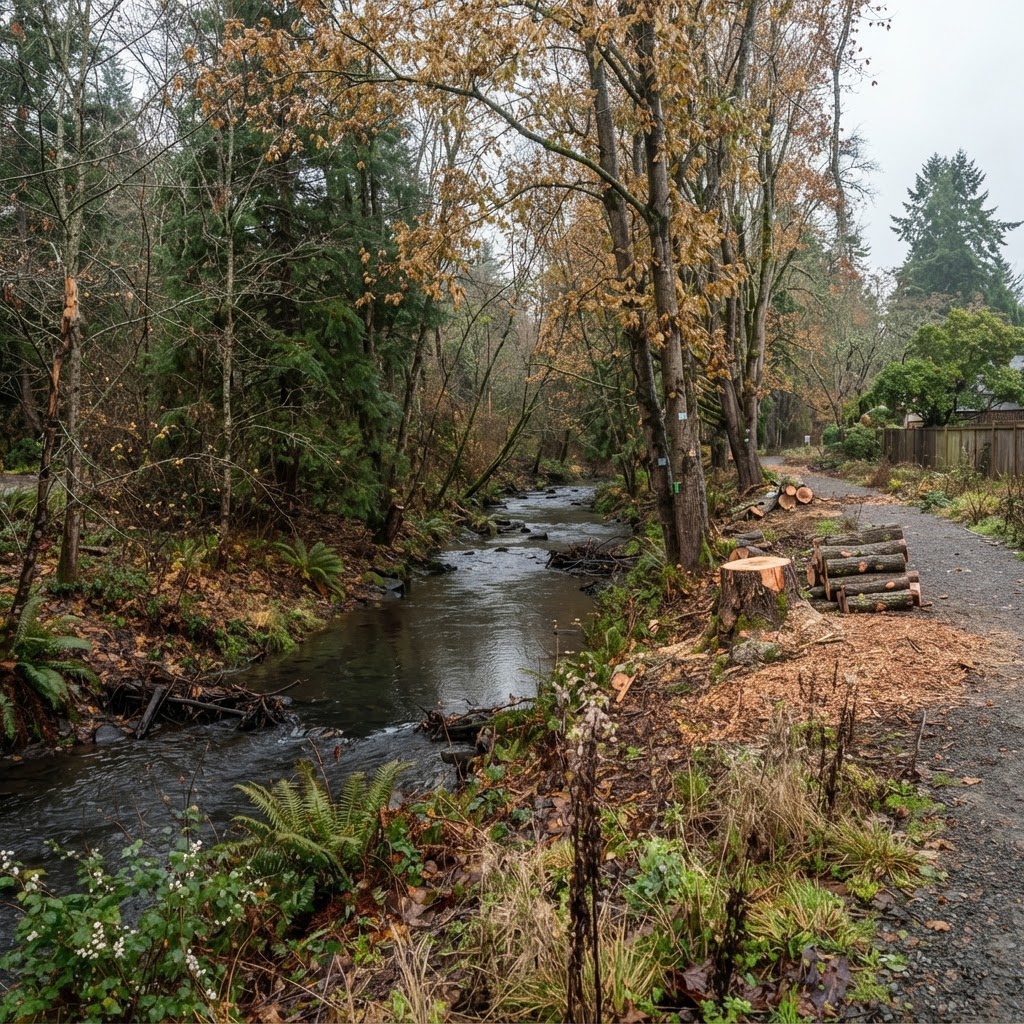
Community discussions are focused on expanding native urban biodiversity and balancing riparian canopy health with beaver activity along corridors like Fanno Creek. The Beaverton Downtown Association recently completed a 10-stop downtown Pollinator Pathway and backed a city resolution to secure Bee City USA status, prompting resident calls for reduced pesticide applications and expanded native plantings across municipal landscapes (Beaverton Beat). Concurrently, recent Portland State University survey work in Beaverton highlights resident concerns over tree protection along waterways, as state wildlife protections prohibit lethal beaver deterrence, driving demand for non-lethal tree wrapping and basin-wide coexistence strategies (Beaverton Beat).
Ecosystem Challenge & Solution
The primary threat facing Beaverton's canopy is the emerald ash borer (EAB), which was officially confirmed within city limits at Greenway Park and nearby Washington County sites (Oregon Department of Forestry Newsroom, Protecting Our Urban Forest | Beaverton, OR - Official Website). As adult beetle flight has concluded for the late autumn and winter seasons, the Oregon Department of Forestry advises that arborists and property managers can now safely proceed with pruning, removals, and sanitation of infested ash trees without the risk of spreading flying adults (November 2026 With EAB adults gone for this year, ash pruning/removals can resume). To restore structural diversity in areas prone to ash loss, practitioners and landowners should plant climate-resilient native riparian alternatives such as Oregon white oak (Quercus garryana) or bigleaf maple (Acer macrophyllum), and report suspected EAB signs at OregonEAB.com (Protecting Our Urban Forest | Beaverton, OR - Official Website).
Volunteer & Planting
While the city's Urban Forestry team previously coordinated with Friends of Trees and local volunteers to plant over 2,000 native trees and shrubs to mitigate ash mortality, no specific public planting dates are scheduled for today (Protecting Our Urban Forest | Beaverton, OR - Official Website). Tree stewards seeking active opportunities can join the Beaverton Downtown Association's Bee City USA committee and pollinator habitat working groups to support ongoing native habitat installations (Beaverton Beat).