City Intelligence · 11/23/2026
Canopy Daily · Nov 23: Kirkland Targets Urban Forest Management Plan Updates Amid Canopy Declines
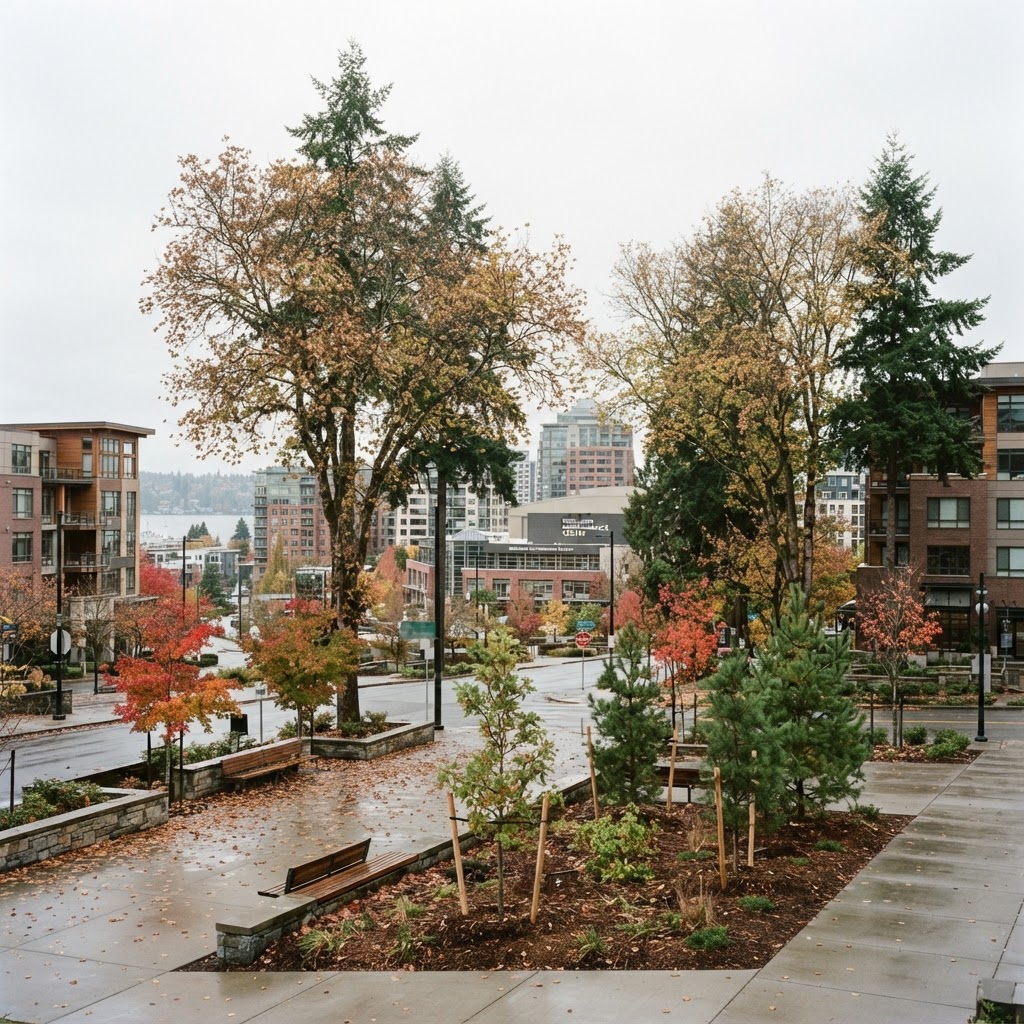
Kirkland is focusing on its 2026 Urban Forest Management Plan update after citywide canopy assessments revealed an overall loss of more than 300 acres, concentrated heavily in single-family residential areas. Local tree stewards and arborists are navigating strict permit fee structures, landmark mitigation rules, and fall planting standards to restore coverage toward the city's 40 percent goal.
Regulations & Permits
Under the City of Kirkland's tree regulations, standard tree removal permits cost $600 and Landmark tree removal permits cost $300, both subject to an additional 3.5% online surcharge, plus a mandatory $305 recording fee for required mitigation trees. Under KZC 95.23, removing a landmark tree requires planting three approved large-species replacement trees (or paying a $450 fee-in-lieu per tree) backed by a mandatory five-year recorded maintenance agreement. Tree stewards must also observe KMC 1.12.100, which enforces steep civil fines ranging up to $20,000 to $30,000 for unauthorized removals or damaged critical-area trees.
Community Concerns
Canopy loss driven by redevelopment remains a top public concern. The city's 2026 Urban Forest Management Plan Update indicates citywide tree cover declined from 40% in 2010 to roughly 38% in 2021, driven primarily by single-family residential areas where non-development tree removals documented about 1,000 trees annually. Grassroots groups like the Finn Hill Neighborhood Alliance have voiced growing concern that infill housing, accessory dwelling units (ADUs), and private lot grading threaten critical ravine ecosystems and neighborhood tree canopy across high-coverage zones.
Ecosystem Challenge & Solution
Late-fall Pacific Northwest windstorms and saturated soils pose significant branch-failure and root-plate destabilization risks in Kirkland's wet season. To improve wind resilience and structural root strength, stewards and arborists should prioritize structural pruning, avoid over-saturating disturbed construction soils, and adhere to KZC 95.50 planting standards between October and April. A robust native solution for planting in local moist soils and ravines is Western redcedar (Thuja plicata) or Douglas-fir (Pseudotsuga menziesii), which provide deep slope stabilization, excellent stormwater interception, and vital wildlife canopy cover.
Volunteer & Planting
No specific upcoming volunteer stewardship or public planting events were found for today's date in local city announcements. However, late fall is the city-designated primary planting window under KZC 95.50, and community members are encouraged to monitor city volunteer networks or contribute input toward ongoing canopy policy revisions outlined in the Urban Forest Management Plan Update.