City Intelligence · 11/22/2026
Canopy Daily · Nov 22: Canopy Daily Beaverton: Winter Window for Ash Management Opens as City Faces Regional EAB Spread
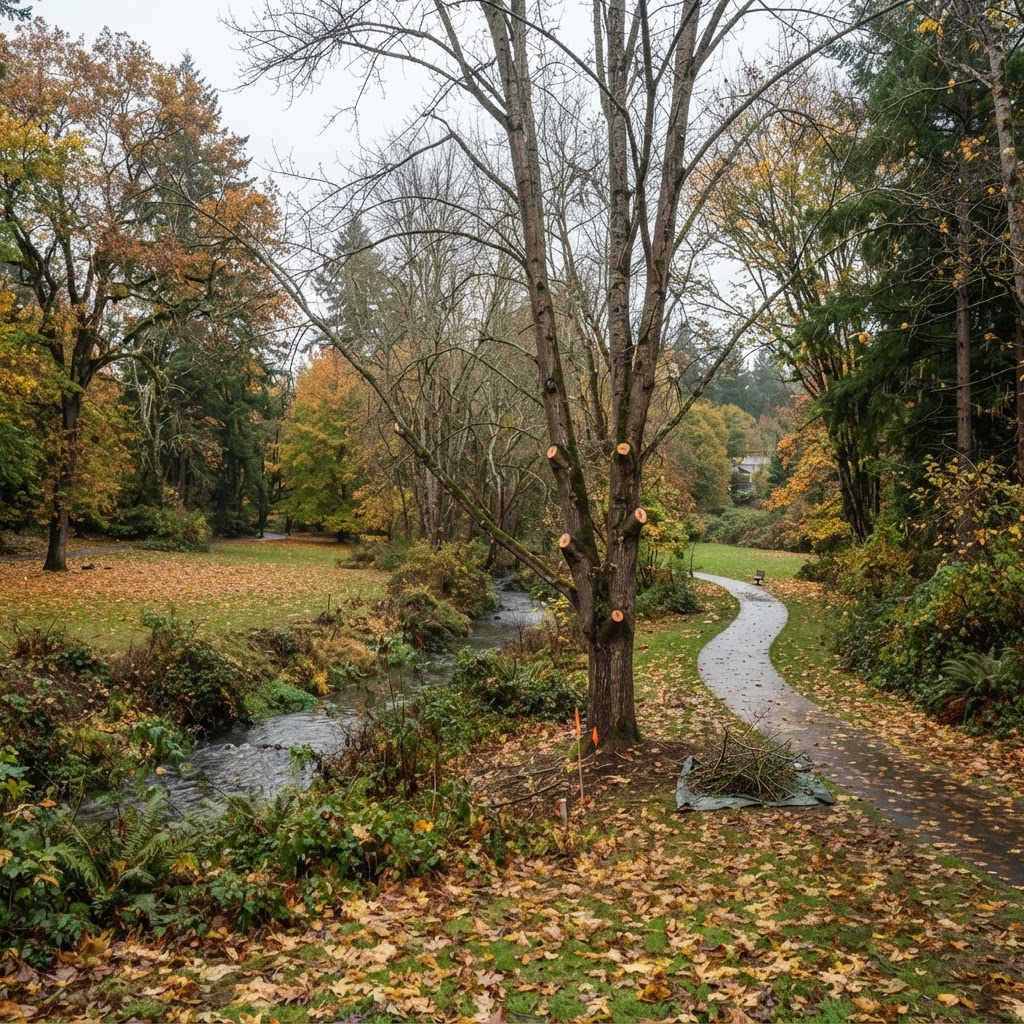
State forestry officials note that seasonal emerald ash borer dormancy now allows dormant-season ash pruning and removals, while local stewards navigate canopy goals and riparian coexistence. Beaverton's urban forestry team continues response efforts following local EAB detections earlier this year.
Regulations & Permits
According to the Oregon Department of Forestry's November 2026 update, emerald ash borer (EAB) adult flight is completed for the year, meaning arborists and property owners can resume necessary pruning and removal of ash trees without risking adult beetle dispersal (Oregon Department of Forestry Bulletin). However, Washington County remains under the Oregon Department of Agriculture's wood quarantine covering ash, olive, and white fringetree, restricting the unmanaged transport of regulated material outside the designated five-county zone (ODF Urban Forests). Locally, tree care practitioners are reminded that Beaverton Code 5.05.098 requires property owners to keep clearance zones trimmed to a minimum of 10 feet over roadways and 8 feet over sidewalks, and prohibits leaving standing hazardous or dead trees that threaten the public right-of-way (Beaverton Code 5.05.098).
Community Concerns
Community advocacy for green spaces is actively visible downtown, where the Beaverton City Council recently considered an official Bee City USA affiliation backed by the Beaverton Downtown Association's Pollinator Pathway project to expand native habitat (Beaverton Beat). Simultaneously, residents and land managers along Fanno Creek are managing coexistence with urban beavers following Oregon's reclassification of the animal as a protected furbearer, balancing the species' watershed benefits against riparian tree damage (Beaverton Beat). Meanwhile, the city's Climate Action Dashboard shows that broader structural canopy targets—including the development and adoption of a comprehensive Urban Forestry Master Plan—remain delayed due to constrained municipal funding and capacity (Beaverton Climate Dashboard).
Ecosystem Challenge & Solution
The dominant seasonal threat to Beaverton's canopy remains the emerald ash borer, which was trapped inside city limits at Greenway Park and nearby Washington County sites earlier this season (Oregon Department of Forestry Bulletin). As untreated ash species face estimated mortality rates of up to 99%, arborists and landowners should inspect dormant stands for D-shaped exit holes, bark splits, and epicormic shoots (City of Beaverton). The city's forestry staff has treated high-value specimen ash trees with trunk injections while shifting proactive replacements away from Fraxinus species; for replacement plantings in local riparian and yard settings, native alternatives such as Oregon white oak (Quercus garryana), western redcedar (Thuja plicata), and red alder (Alnus rubra) provide robust long-term ecological resilience.
Volunteer & Planting
No new formal citywide planting dates were posted for this weekend; however, the Beaverton Downtown Association is currently seeking committee members and volunteers to support public education and habitat installations connected to its Pollinator Pathway initiative (Beaverton Beat). Long-term community planting and restoration efforts along Fanno Creek also remain ongoing through regional watershed partners, augmenting the more than 2,000 native trees and shrubs recently added by Beaverton's Urban Forestry team (City of Beaverton).