City Intelligence · 11/22/2026
Canopy Daily · Nov 22: Canopy Daily Vancouver: Winter Planting Target Expansion and Tree Protection Standards
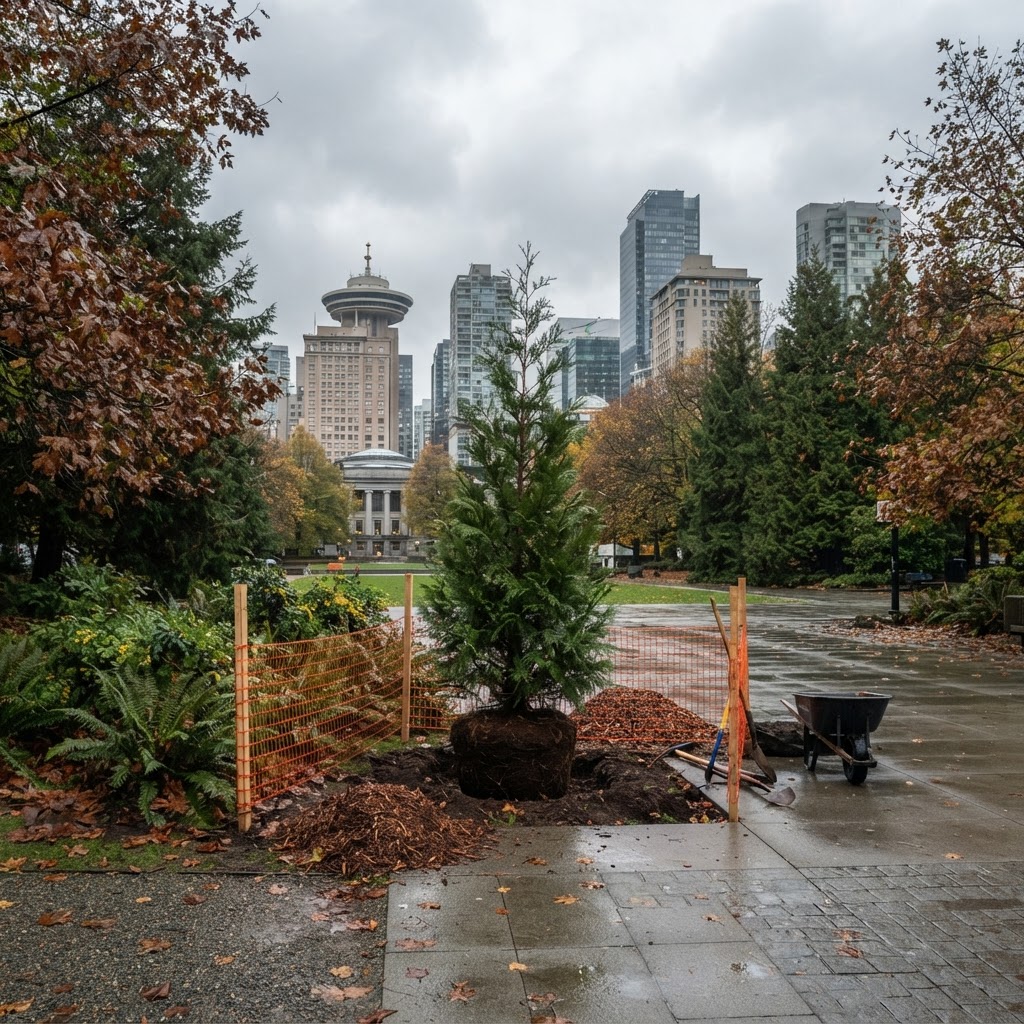
Vancouver urban forestry teams are ramping up seasonal winter tree planting initiatives aimed at bridging canopy equity gaps across low-shade neighbourhoods. Local arborists and property stewards must maintain strict adherence to By-law No. 9958 permit thresholds and approved protection barrier clearances on active sites.
Regulations & Permits
Under the City of Vancouver's Protection of Trees By-law No. 9958, a permit is mandatory to remove or kill any tree with a diameter of 20 cm or greater at 1.4 m above grade, as well as replacement and hedge trees. Under By-law No. 14546 (effective 2026-01-01), permit fees stand at $113 for the first tree within a 12-month window and $324 for each additional tree (Arborist Group). For development and construction, permits cannot be released until the Chief Building Official inspects and approves Schedule A tree protection barriers—which range from 1.2 m for 20 cm DBH trunks to 6.0 m for 100 cm trunks—with street-side barriers requiring a 0.6 m curb clearance and Park Board sign-off (Arborist Group). No new Environmentally Sensitive Area (ECA) code updates were reported today.
Community Concerns
Canopy equity remains a central focus for Vancouver residents and tree advocates, particularly in heavily paved, historically tree-deficient areas such as Marpole and the Downtown Eastside, where urban heat island impacts are acutely felt (City of Vancouver). Community stewardship conversations continue to emphasize the aggressive implementation of the city's updated Urban Forest Strategy goal to boost overall municipal canopy coverage from 25% to 30% by 2050 (City of Vancouver).
Ecosystem Challenge & Solution
A recurring challenge for Vancouver's urban canopy is soil compaction, restricted root space, and waterlogging or severe drought in heavily paved corridors, compounded by vulnerability to intense storms (City of Vancouver). The practical urban forestry solution is the installation of specialized structural soil tree pits beneath sidewalks, providing stable rooting volume, better drainage, and reduced infrastructure conflicts. For resilient plantings in challenging soils, Pacific crabapple (Malus fusca) or Garry oak (Quercus garryana) serve as strong, climate-adaptive native species options suited to fluctuating Pacific Northwest soil conditions.
Volunteer & Planting
The City of Vancouver's Urban Forestry team conducts active street and park tree planting from November through April, utilizing Green Municipal Fund support to deliver over 3,000 new trees across six target neighbourhoods through 2026–2027 (City of Vancouver, City of Vancouver). While specific volunteer event dates for today were not published in municipal bulletins, residents and stewards can support canopy initiatives by enrolling in seasonal boulevard stewardship and monitoring newly planted boulevard trees via the City's Adopt-a-Tree resources (City of Vancouver).