City Intelligence · 11/22/2026
Canopy Daily · Nov 22: Everett Advances Tree Code Updates and Expands Tree Equity Plantings
Everett officials and parks leadership are actively reviewing revisions to the city's Tree Management Code and Landscape Ordinance to strengthen urban forest protections. Meanwhile, local partnerships with the Snohomish Conservation District are targeting neighborhood equity through ongoing fall planting initiatives and soil restoration work.
Regulations & Permits
City departments, including Parks and Planning, are actively collaborating on updates to Everett's foundational tree and landscape regulations, specifically the Tree Management Code (EMC 8.40) and the Landscape Ordinance (EMC 19.35), as reported by the City of Everett Parks & Recreation Department. For current field work, tree removal or pruning outside environmentally critical areas (ECAs) and non-development single-family lots generally does not require a permit, but strict rules govern commercial, multifamily, post-1990 subdivisions, and ECA buffers under Tree Removal Permits in Everett, WA and Everett Municipal Code 19.37.060. In critical areas, pruning is capped at 33% of the crown, tree topping and pollarding are prohibited, and hazard tree removals require city approval along with a mandatory two-for-one native tree replacement.
Community Concerns
Advocacy in Everett remains focused on canopy equity, long-term park planning, and balancing infrastructure with mature street trees. Community leaders recently reviewed the city's upcoming Parks, Recreation and Open Space (PROS) Plan, which begins development in 2027 to direct tree acquisitions and capital investments through 2034, according to the City of Everett Parks & Recreation Department. Residents and merchants along central corridors like the Colby Avenue median have expressed ongoing interest in right-of-way management, where arborists are carrying out structural pruning, limb reductions, removals of compromised trees, and targeted air-spading operations to resolve growing space conflicts with sidewalks and utilities.
Ecosystem Challenge & Solution
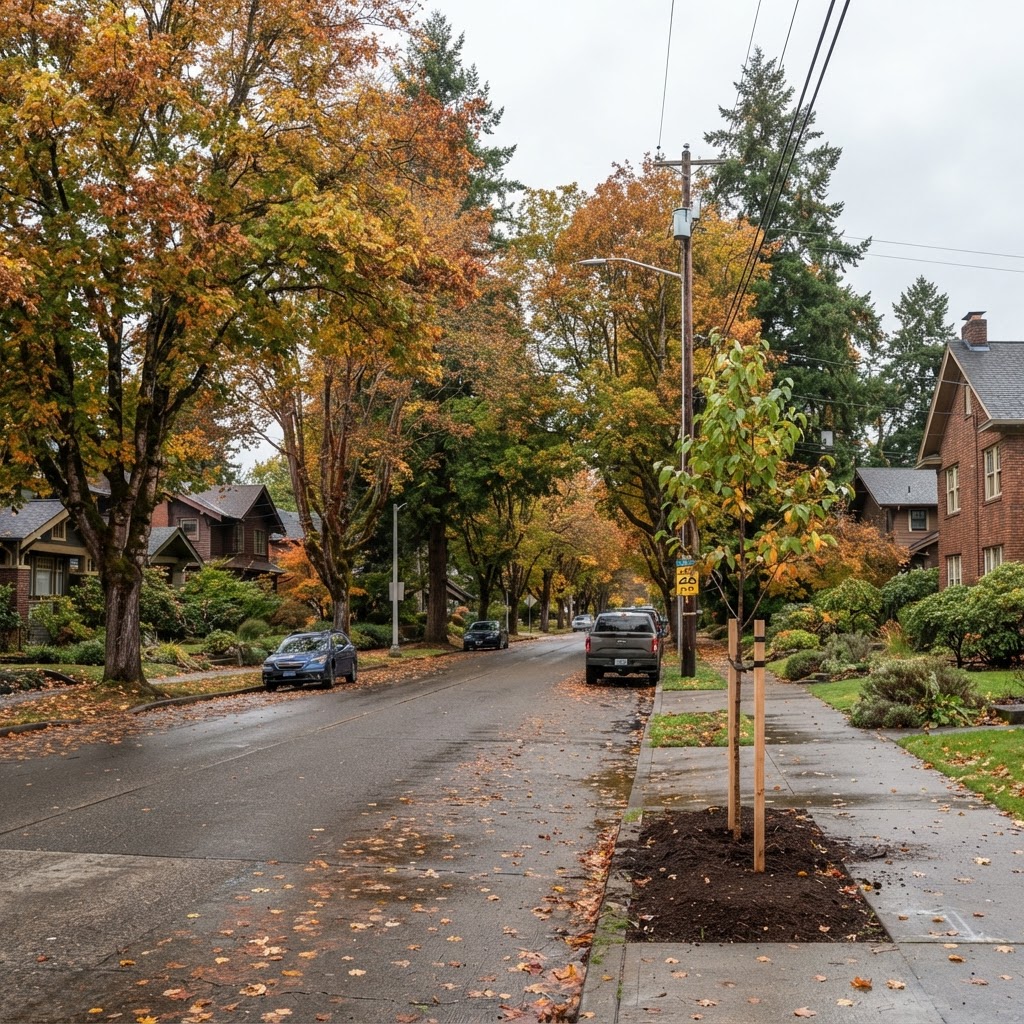
Late-autumn in the Puget Sound brings seasonal windstorms and heavy saturation to Everett's dense glacial till and compacted urban soils, posing significant uprooting and root-rot risks for legacy trees. To alleviate severe root-zone compaction and improve aeration without severing structural roots, crews are deploying pneumatic air spading and targeted mulch rings along street corridors, as highlighted in city work detailed by the City of Everett Parks & Recreation Department. For planting in moist, stormwater-prone soils, stewards should incorporate hardy native species such as Western redcedar (Thuja plicata) or Pacific willow (Salix lucida), which thrive in saturated ground and provide excellent soil stabilization against runoff.
Volunteer & Planting
Eligible residents in designated priority neighborhoods can still register to receive free yard and street trees through the Snohomish Conservation District's Urban & Community Forest Program, which aims to plant thousands of trees across Everett by 2028. Additionally, the district and city continue their seasonal planting campaigns targeting sites like Legion Park, Jackson Park, and Walter E. Hall Park to add over 70 new canopy trees, with signups coordinated via the Snohomish Conservation District Urban & Community Forests. No other new public volunteer planting dates were announced today.