City Intelligence · 11/21/2026
Canopy Daily · Nov 21: Bellevue Code Amendments Reinforce Tree Density and Buffer Protections
Bellevue's recent codification of Ordinances 6932 and 6934 establishes strict review and replanting rules across development sites, critical areas, and residential lots. Current permit notices illustrate heightened scrutiny around stream buffers, while seasonal storm saturation requires proactive root and soil management.
Regulations & Permits
Bellevue has updated its regulatory framework with Ordinance 6932 amending Land Use Code 20.20.900 Tree retention and replacement and Ordinance 6934 amending Clearing and Grading Code Chapter 23.76, both codified in October 2026. Under 23.76.035 Permit requirements and 23.76.060 Clearing – Vegetation preservation and replacement, a permit is mandatory to remove any significant tree (minimum 6-inch diameter) or landmark tree (24 inches or greater) outside development, or to prune more than 25 percent of a preserved tree's live crown within a three-year period. Development applications must meet strict minimum tree density standards emphasizing retention; newly planted deciduous trees must be at least two inches in caliper and conifers at least six feet tall to yield credits, while planted alders and cottonwoods provide zero credits. Work within Critical Area Overlays (such as steep slopes and stream buffers) remains governed by strict critical area standards, requiring qualified tree professional assessments and formal city review.
Community Concerns
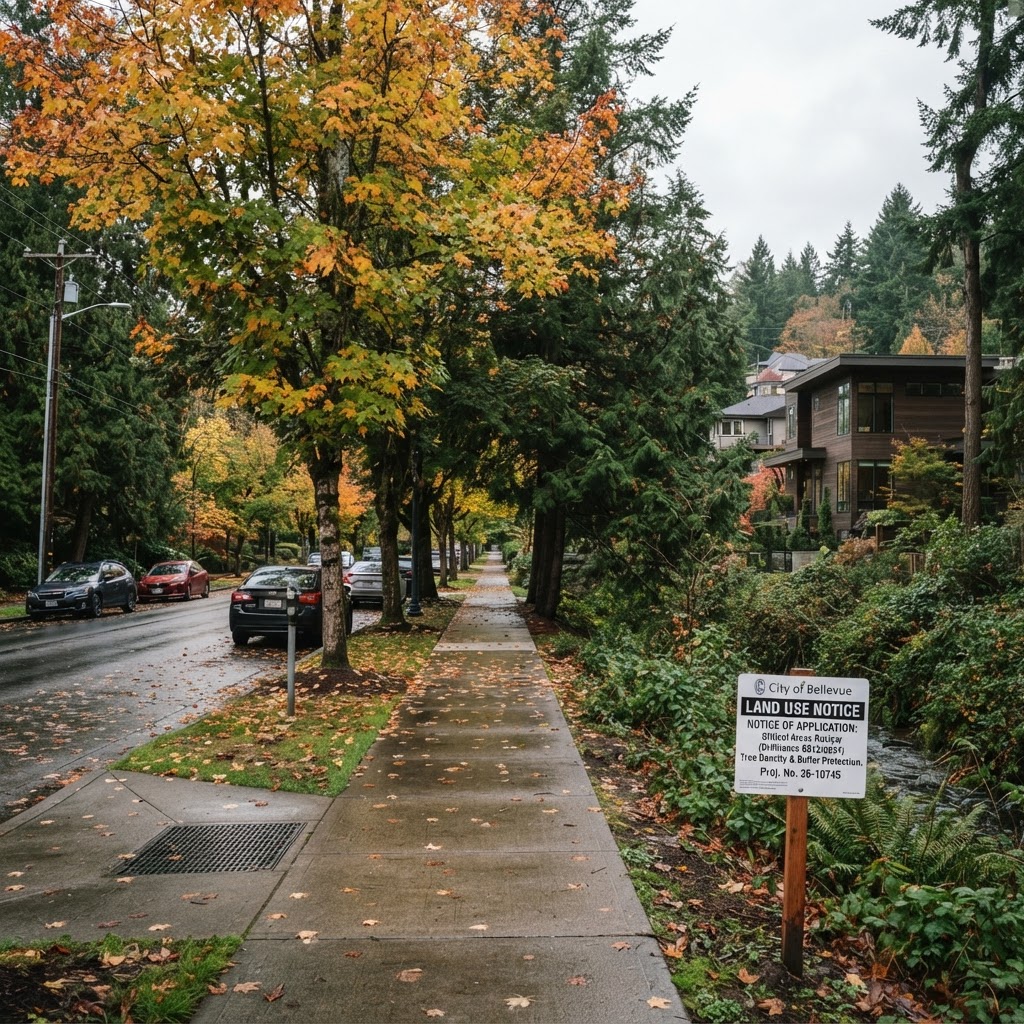
Community interest remains tightly focused on canopy loss within sensitive ecological corridors and critical area buffers. According to the city's Weekly Permit Bulletin published November 18, 2026, land use reviews are actively tracking tree removals in stream buffers across Eastgate and Lake Hills. A recent threshold determination approved the removal of multiple birch, ash, cherry, and eight bigleaf maples alongside invasive species in a 75-foot stream buffer on SE 1st Street, requiring 13 replacement trees to offset the loss (with the public SEPA appeal window closing December 2, 2026). Residents and advocates continue monitoring these proposals to ensure required replanting plans and erosion mitigation keep pace with hazard removals and invasive control near local waterways.
Ecosystem Challenge & Solution
Late autumn in Bellevue brings heavy seasonal rains and windstorms, exposing shallow root plates to waterlogged, compacted urban soils and increasing windthrow vulnerability. The City of Bellevue's Street Trees and Arterial Landscapes guidance emphasizes that limited rooting volume, reflected heat, and compaction from traffic severely impede root anchorage. To resolve this, arborists and stewards should aerate compacted zones around drip lines and apply a 2- to 4-inch layer of coarse arborist wood chips, keeping mulch away from root flares to protect fungal health and facilitate deep infiltration. For new or replacement plantings in wet or riparian-adjacent residential settings, consider Western redcedar (Thuja plicata) or Douglas-fir (Pseudotsuga menziesii), ensuring selections conform to city-approved PNW native standards outlined in LUC 20.20.900.
Volunteer & Planting
No new municipal volunteer planting events are posted on official schedules for today. Bellevue's signature community tree distribution, the annual Tree Giveaway program run in partnership with Amazon and 300 Trees, completed its yearly cycle with tree pickups concluding in October. Stewards wishing to assist the urban forest through late fall are encouraged to help clear drainage swales around newly planted street trees and monitor neighbor tree bags and stakes following November wind events.