City Intelligence · 11/13/2026
Canopy Daily · Nov 13: Cook County & Chicago Urban Forestry Brief for Nov. 13, 2026
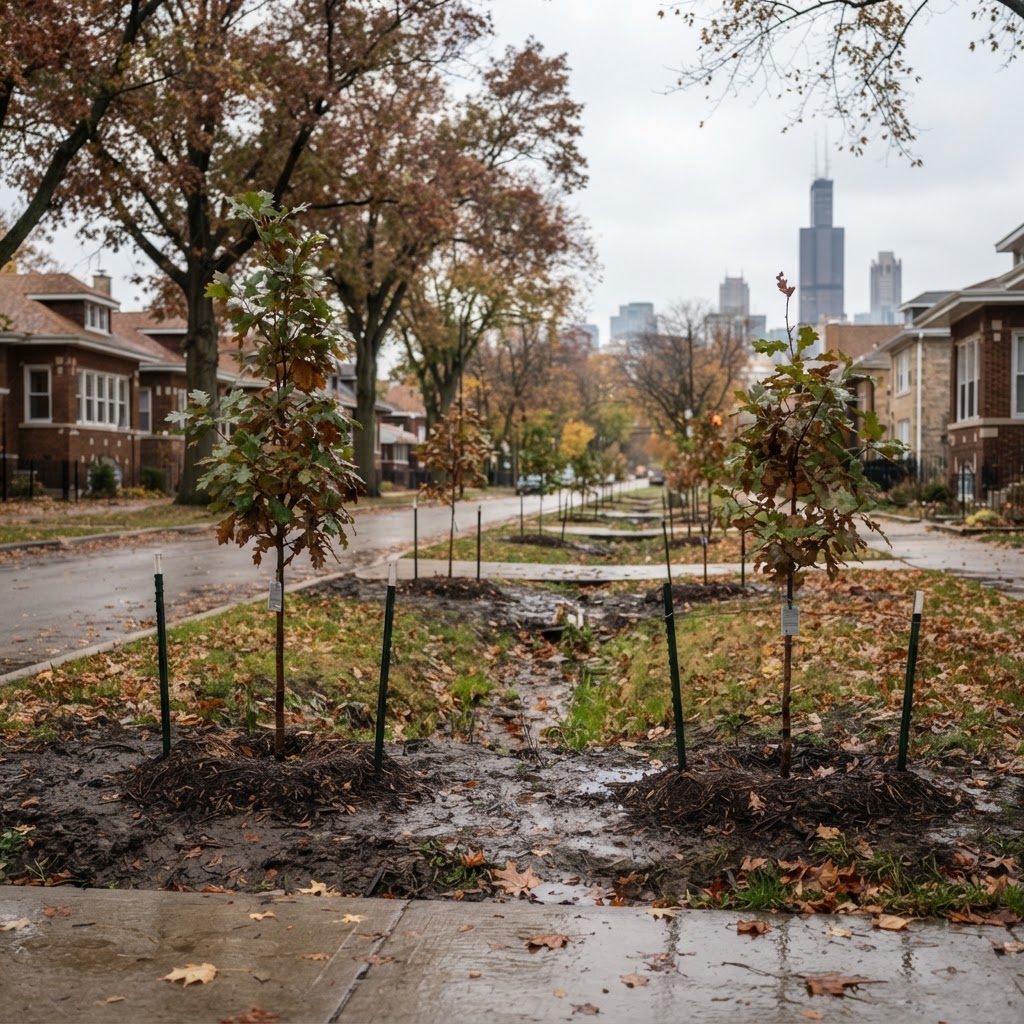
As Chicago nears its 75,000-tree planting benchmark under the Our Roots program, forestry advocates are pressing City Council budget hearings for dedicated senior forester positions to maintain young canopy. Meanwhile, regional stewards are tackling severe urban stormwater retention and poorly draining clay soils by deploying resilient native oak flatwood plantings across Cook County.
Regulations & Permits
In municipal compliance updates, the City of Hometown in Cook County enacted Ordinance No. 6-2026, establishing Section 18.24 of the municipal code, which requires a $25 permit for removing any tree over 20 feet tall, restrictively requiring work to be done by licensed, insured contractors except in bona fide emergencies (City of Hometown Ordinance No. 6-2026). In the City of Chicago, arborists and contractors are reminded that any maintenance, root pruning, or removal of public parkway trees requires a Bureau of Forestry permit via the Department of Streets and Sanitation, limited strictly to insured tree service firms (Parkway Tree Permits and Protection on Chicago Job Sites). No new Environmentally Critical Area (ECA) code amendments were enacted this week.
Community Concerns
Urban canopy advocates are focusing heavily on municipal capacity during Chicago City Council budget hearings. Spokespeople from Openlands warned the Committee on Budget and Government Operations that while the city will reach its 75,000-tree planting milestone this month, the newly planted parkway trees face high mortality risks without restoring vacant senior city forester roles to supervise establishment and operationalize the city's ongoing tree inventory (Chicago budget panel told newly planted trees need more foresters to survive, Chicago forestry advocates press budget committee to add senior forester positions). Meanwhile, south side communities like Chatham continue pushing for targeted plantings and green infrastructure after facing record summer precipitation that overwhelmed local sewer lines (Chatham Tree Planting Targets Chicago Flooding Crisis).
Ecosystem Challenge & Solution
Seasonal Challenge: Late autumn brings soil saturation compounded by dense regional clay subsoils, which create severe drainage swings ranging from prolonged waterlogging in wet months to compaction stress. Solution: The Forest Preserves of Cook County are addressing these fluctuating conditions at Harms Woods by establishing native flatwood plantings using swamp white oak (Quercus bicolor) alongside bur oak (Quercus macrocarpa). Swamp white oak is uniquely adapted to thrive in heavy, poorly drained clay that experiences alternating standing water and seasonal drying, providing stormwater mitigation while resisting local hydrologic extremes (Planting the Seeds of a Future Forest at Harms Woods).
Volunteer & Planting
Stewards have multiple immediate volunteer opportunities across Cook County organized through Openlands: Friday, Nov. 13 features a habitat restoration workday with the Forest Preserves of Cook County at Axehead Lake (9:00 AM–11:30 AM). On Saturday, Nov. 14, volunteers can attend a TreeKeepers pruning workday in Hyde Park's Nichols Park (9:00 AM–12:00 PM) or a mulching and pruning workday at Palmisano (Henry) Park in Bridgeport (10:00 AM–12:00 PM) (Volunteering | Openlands).