City Intelligence · 11/12/2026
Canopy Daily · Nov 12: Landmark Tree Rule Transitions and Forest Soil Health in Bellingham
Bellingham tree managers and stewards face shifting rules as the city moves toward permanent landmark tree protections alongside standard street tree permitting. Meanwhile, urban park efforts focus on mitigating chronic soil compaction to protect native conifers as autumn planting season ramps up.
Regulations & Permits
In Bellingham, cutting or altering trees measuring 36 inches or greater in diameter at breast height (DBH) remains restricted under the city's interim Landmark Tree Ordinance while staff transition the measure into permanent code (City of Bellingham). A certified arborist's evaluation and tree protection plan may be required before permits or land-use approvals involving landmark specimens are granted. Additionally, street tree maintenance is governed by Bellingham Municipal Code 13.40.060, which mandates a permit from the Parks and Recreation Department for major pruning, removal, or planting within rights-of-way, and explicitly bans tree topping as a standard practice (Bellingham Municipal Code).
Community Concerns
Community discussions remain divided over the final shape of the permanent Landmark Tree Ordinance (My Bellingham Now). Canopy advocates emphasize preserving exceptional mature trees to achieve Urban Forest Plan and Climate Action Plan goals, but local developers have raised concerns that strict retention requirements delay critical housing development. Recent draft revisions proposing clearer removal exceptions for hazardous conditions or damage to real property reflect this ongoing debate between urban density and canopy retention.
Ecosystem Challenge & Solution
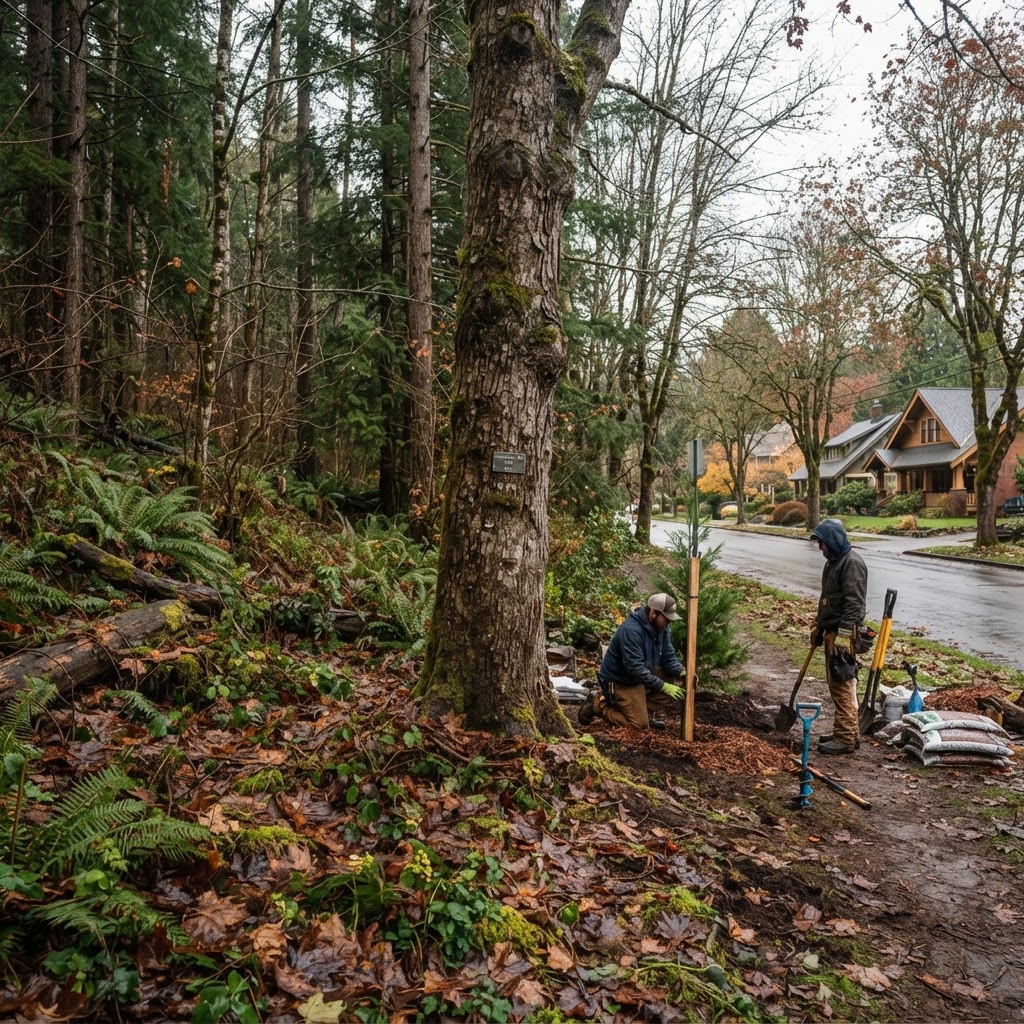
Severe soil compaction driven by heavy foot traffic in urban woodlands—such as the active disc golf and trail corridors in Cornwall Memorial Park—is starving mature conifer roots of oxygen and water, leading to decline and tree removals (City of Bellingham). The practical solution being implemented is temporary exclusion fencing to restrict traffic, supplemented by decompaction and mulch application. To rebuild resilient canopy layers in degraded understories, stewards recommend planting hardy native species such as Western Red Cedar (Thuja plicata), Douglas Fir (Pseudotsuga menziesii), or Western Hemlock (Tsuga heterophylla).
Volunteer & Planting
Fall planting opportunities are active across Whatcom County. On Sunday, November 15, 2026, the Whatcom Million Trees Project is hosting a volunteer planting event at Jensen Family Forest Park at 12:00 p.m. to expand native forest cover (The Volunteer Center of Whatcom County). Later in the month, residents can collect free tree saplings for private yards at the City of Bellingham's Community Tree Programs booth at the Bellingham Farmers Market on Saturday, November 28, from 10:00 a.m. to 2:00 p.m. at Depot Market Square (City of Bellingham).