City Intelligence · 11/11/2026
Canopy Daily · Nov 11: Atlanta Weighs Stricter Tree Preservation While Gearing Up for Citywide Plantlanta Weekend
Atlanta City Council continues deliberation on Ordinance 26-O-1533 aimed at tightening preservation standards toward the city's 50% canopy goal. Meanwhile, arborists and community stewards are preparing for a major November planting weekend alongside active regional discussions on development-driven tree loss.
Regulations & Permits
In the City of Atlanta, Ordinance 26-O-1533, introduced by Councilmember Mary Norwood to amend Chapter 158 (Vegetation) Article II (Tree Protection), remains under committee review after being returned as held in recent council cycles. The proposed measure aims to bolster tree preservation standards to support the city's 50% canopy cover target by establishing defined priority tree tiers, mandating 2-year post-Certificate of Occupancy maintenance for required plantings, and restricting land disturbance removals in subdivisions. Current operational standards under Chapter 158 enforce removal permits for regulated private trees (hardwoods 6 inches DBH and up, pines 12 inches DBH and up) and establish tree recompense at $140 per caliper inch, with mandatory ANSI A300 and ISA compliance for work affecting public right-of-way canopy.
Community Concerns
Across metro Atlanta, community advocacy is sharply focused on commercial and residential development pressure driving urban deforestation. A recent canopy assessment in neighboring DeKalb County revealed that development accounts for roughly 80% of local tree canopy loss, triggering public engagement sessions on overhauling legacy tree ordinances and involving arborists earlier in site planning. Within Atlanta city proceedings, council members continue balancing housing density and development with canopy protections, while recent legislative filings also address municipal Tree Trust Fund allocations and board confirmations for the Tree Conservation Commission.
Ecosystem Challenge & Solution
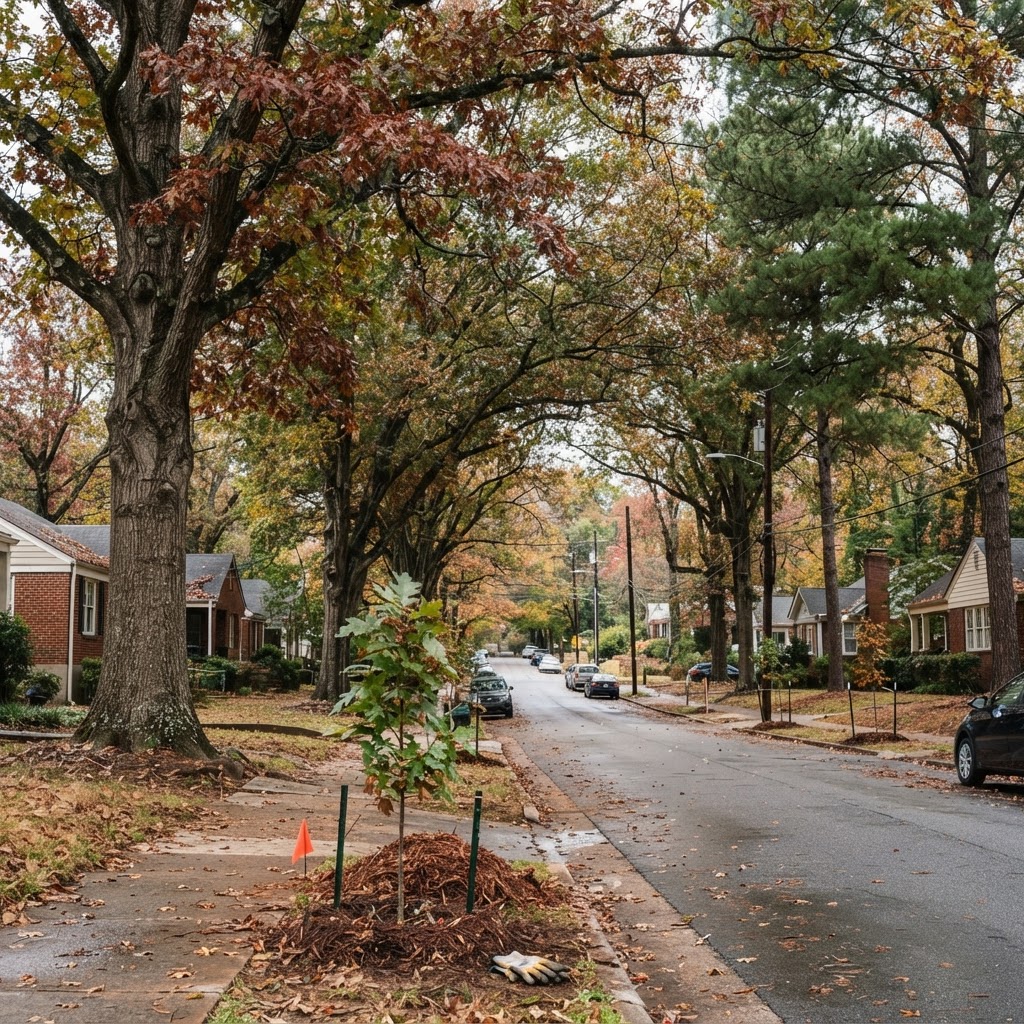
In mid-November, Piedmont soils frequently face compaction and moisture fluctuations as native trees enter dormancy, leaving root zones vulnerable during late-autumn wind events and dry spells. A practical arborist and homeowner fix is establishing a 2- to 4-inch layer of coarse, organic wood-chip mulch around the root zone out to the drip line—keeping mulch at least 3 inches clear of the root flare to avoid fungal decay and rodent girdling. For fall planting initiatives, White Oak (Quercus alba) or Swamp White Oak (Quercus bicolor) serve as ideal native overstory choices, providing long-term structural resilience, superior storm resistance, and critical habitat for local biodiversity.
Volunteer & Planting
Volunteers and stewards can participate in Trees Atlanta's upcoming flagship event, Plantlanta 2026, scheduled for Friday and Saturday, November 13 and 14, 2026. The weekend mobilization aims to plant approximately 700 trees across 12 City Council districts, with Friday work sites including D.H. Stanton Park in Peoplestown, Mechanicsville, and Piedmont Park in Midtown. Tasks involve digging, root untangling, planting, and mulching, with advance sign-ups available online through Trees Atlanta's event portal.